
Field notes · Origin
Uji, Shizuoka and Kagoshima.
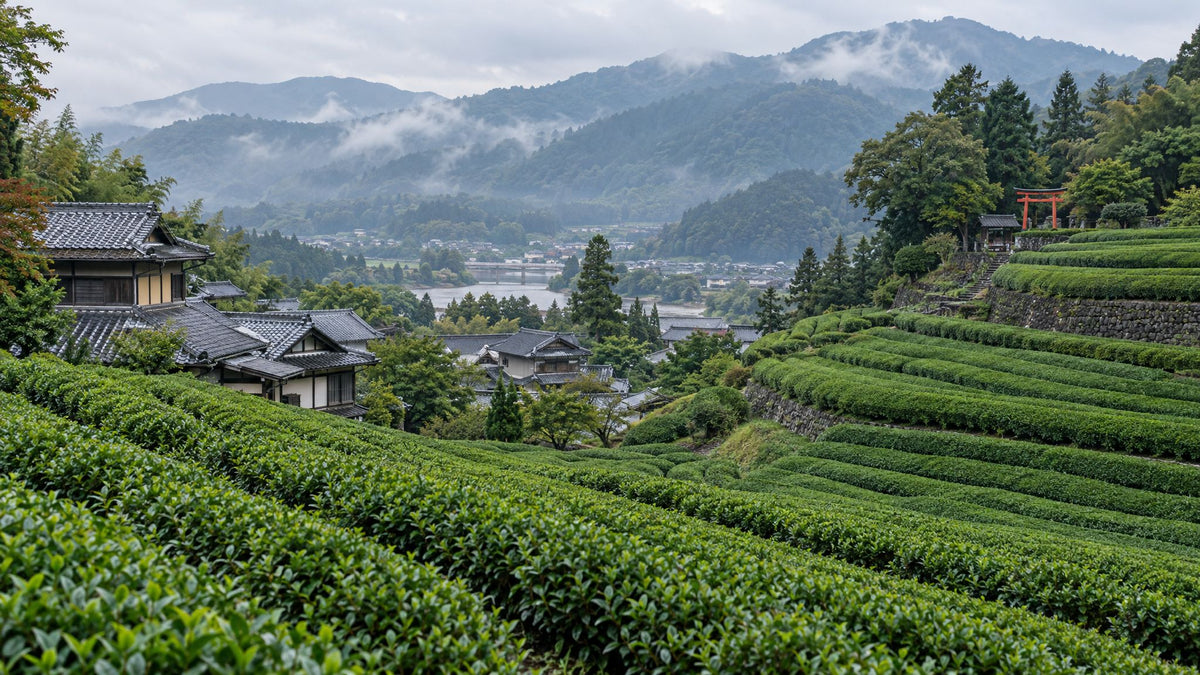
Japan's three big matcha names, compared with the government's newest numbers. Kagoshima now grows the most. Uji still sets the standard. Shizuoka is where Japanese green tea grew up.
HHiro OkumuraTea farmer, TeafyPublished 11 November 20266 min read
The short answer
Uji (Kyoto) is the historic home of matcha and still ranks second in Japan for tencha. Kagoshima became Japan's largest tea producer in 2024 and ranks first for tencha. Shizuoka has the most tea land, grows mainly sencha and ranks third for tencha (MAFF, 2025 crop). Uji matcha is prized for depth and umami, Kagoshima for bright colour and sweetness, Shizuoka for balance.
In this guide
The three regions side by side
Source: MAFF 茶をめぐる情勢, October 2026. Reuters reported in July 2025 that Kyoto makes about a quarter of Japan's tencha.
Look at Kyoto's number. Small. Under a tenth of Kagoshima. Yet Kyoto ranks second for tencha. Almost everything Uji grows is shaded leaf for matcha and gyokuro. It is a specialist, not a volume grower.
Each region in its own words
Uji, Kyoto
Shaded tea growing for matcha was developed in Uji, and the town still sets the benchmark. Gardens are small, often hand tended, and many grow heritage cultivars such as Okumidori, Samidori and Gokō. Expect deep, savoury umami and a long finish.
Shizuoka
Japan's largest area of tea land and the home of sencha, especially fukamushi, deep steamed sencha. Shizuoka ranks third for tencha and is growing it fast as growers convert sencha fields. Our family farm is here.
Kagoshima
On Japan's warm southern tip, Kagoshima harvests earliest, on flatter land, with more machines. It overtook Shizuoka as Japan's largest crude tea producer for the 2024 and 2025 crops, and now makes more tencha than any other prefecture.
Our tasting notes, scored 1 to 5. Farm, cultivar and harvest matter more than the map.
Deep and savoury.
Balanced and smooth.
Bright and sweet.
Why the land shapes the leaf
- Uji: river mist and old gardens. The Uji river valley brings morning mist that softens sunlight. Small, sloping gardens are worked by hand.
- Shizuoka: mountains and the sea. Tea grows from coastal plains to high valleys. Mountain tea grows slowly and stays fragrant; plain tea is suited to deep steaming.
- Kagoshima: warm and flat. A long growing season and wide fields suit machine picking and many cultivars. Spring arrives first.
- All three: shading, harvest and milling change the cup more than the place name on the tin.
Approximate first flush windows.
A short history: from Eisai to 2026
Eisai's book opens with a line still quoted in Japan: 「茶也、養生之仙藥也、延齡之妙術也」. Tea is the elixir for nourishing life, and a wondrous way to lengthen it.
From temple gardens, tea moved to Uji, where shaded growing for matcha took shape. Shizuoka later built its industry on Nagatani Sōen's sencha method, and the two grew in different directions: Uji toward matcha and gyokuro, Shizuoka toward sencha.
Why blends exist
Every region brings something. Kagoshima's early, bright leaf. Shizuoka's balance. Miyazaki's sturdy body. A blend lets a tea maker hit the same flavour every year, even when one region has a hard spring.
Our Superior Culinary blends organic leaf from Shizuoka, Kagoshima and Miyazaki, so it tastes the same in your latte in January as in July.
Which region should you choose?
Monthly Google searches in Australia.
Peak month for uji matcha: Jan. Quietest: Sep.
Google Ads Keyword Planner, Australia, all languages, Google Search. Monthly figures are Google estimates, rounded into ranges.Questions people ask
What is Uji matcha?
Which region in Japan makes the most matcha?
Is Uji matcha better than Shizuoka matcha?
Is Kyoto matcha the same as Uji matcha?
Who brought matcha to Japan?
Hiro Okumura
Tea farmer, Teafy
Hiro is a third generation Japanese tea farmer. He writes about the field: seasons, cultivars, shade and everything that happens to a leaf before it becomes tea.
Sources
- Ministry of Agriculture, Forestry and Fisheries (MAFF), 茶をめぐる情勢, October 2026
- MAFF, 茶をめぐる情勢, July 2026
- Reuters via Malay Mail, 4 July 2025
- Eisai, 喫茶養生記, Wikisource
- Kotobank, 喫茶養生記
- 岩間眞知子, 日本医史学雑誌 64(2), 2018, on the Kissa Yōjōki
- Kyoto Prefectural Tea Cooperative, definition of Uji tea (宇治茶)
- Google Ads Keyword Planner, Australia, searches October 2025 to September 2026, checked 11 November 2026
We update this page when the numbers change, and date every change here.
Teas in this guide
Keep reading
 Matcha cultivars explained
 The matcha shortage, explained
 Japanese vs Chinese matcha
 The Japanese tea ceremony