
Lesson · Culture
The Japanese tea ceremony.
Chanoyu, the way of tea. What happens in the room, how a guest drinks, why there are two kinds of matcha, and the ideas that hold it all together.
EEric HuangTea instructor, TeafyPublished 11 November 20266 min read
The short answer
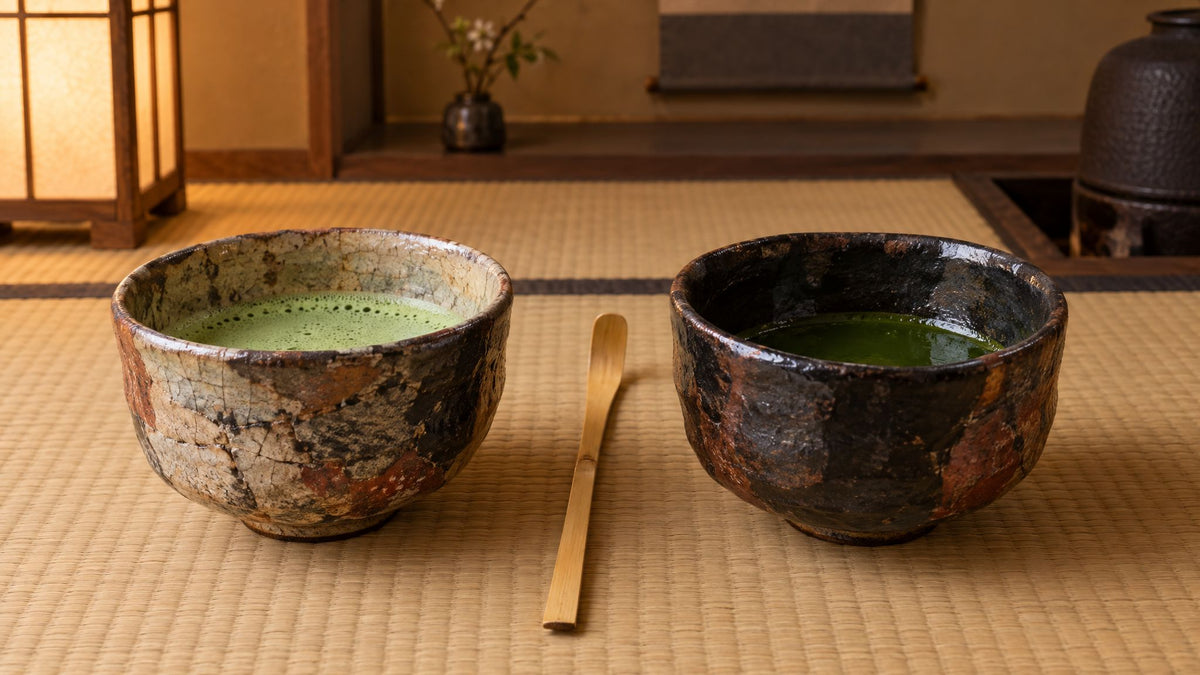
The Japanese tea ceremony, chanoyu (茶の湯) or chadō (茶道), is the ritual preparation and sharing of matcha. A host cleans the utensils, whisks tea in front of guests and serves it with a sweet. Guests bow, turn the bowl so they do not drink from its front, and drink in a few sips. Two kinds of matcha are served: usucha, thin and frothy, and koicha, thick and glossy, made only with the finest first flush matcha.
In this guide
Lesson 1: what the tea ceremony is
Chanoyu (茶の湯) means hot water for tea. Chadō (茶道) means the way of tea. Both name the same practice: a host prepares matcha for guests, slowly and with care, in a set order of movements.
It looks like a ritual about tea. Students learn it is really about attention. Every movement has a reason: to clean, to show respect, or to make the next movement easier.
Wa 和
Harmony. Between host and guest, and with the season.
Kei 敬
Respect. For people and for the utensils.
Sei 清
Purity. Cleaning the utensils is part of the ceremony.
Jaku 寂
Tranquillity. The calm that comes from the first three.
These four words, wa kei sei jaku (和敬清寂), are attributed to Sen no Rikyū and are still taught by the tea schools. Another phrase you will hear is ichigo ichie (一期一会): one time, one meeting. This gathering will never happen in the same way again.
Lesson 2: what happens, step by step
A short gathering (chakai) lasts under an hour. A full chaji with a meal can take about four.
Lesson 3: how to drink as a guest
- Bow to the next guestSay osakini, excuse me for going before you.
- Bow to the hostRaise the bowl slightly in thanks.
- Turn the bowlHold it in your left palm and turn it with your right hand, usually twice, so its front faces away from you. You do not drink from the bowl's best side.
- Drink in a few sipsUsucha is finished in about three sips. A small slurp on the last sip is polite: it says you enjoyed it.
- Wipe the rimWith your fingertips, where your lips touched.
- Turn it back and admire itReturn the front to face you, set the bowl down, and look at it before handing it back.
Lesson 4: usucha and koicha
Koicha concentrates everything, including bitterness. Only the sweetest first flush matcha, from young, well shaded leaves, tastes good that thick. Tea houses in Japan often label their best matcha as suited to koicha.
How to make koicha
- Sift 4 g of matcha into a warmed bowlSifting matters even more here.
- Add about 15 ml of waterHalf the water first.
- Knead slowlyMove the whisk in slow circles and folds, pressing the matcha into the water, not whipping it.
- Add the restAbout 15 ml more. Knead until glossy and smooth with no lumps.
- Drink slowlyIt should coat the bowl and taste deep, sweet and savoury.
Lesson 5: eight centuries of tea
Okakura's book begins: "Tea began as a medicine and grew into a beverage." It is still one of the best short books on the subject, and free to read online.
Lesson 6: the utensils
Lesson 7: seeing a tea ceremony in Australia
Several Japanese tea schools have practising groups in Australia. Demonstrations often appear at Japanese cultural festivals, Japanese gardens and university Japanese societies. Watching one is the best way to understand why the movements, the bowls and the silence matter as much as the tea.
Want to practise at home? You do not need a tea room. A bowl, a whisk, good matcha and ten quiet minutes is the beginning of the way of tea.
Questions people ask
What happens at a Japanese tea ceremony?
What is the difference between usucha and koicha?
Why do you turn the bowl in a tea ceremony?
How long does a Japanese tea ceremony take?
Can any matcha be used for koicha?
Who was Sen no Rikyū?
Eric Huang
Tea instructor, Teafy
Eric is a Taiwanese tea instructor who teaches brewing technique. He writes lessons you can follow at the bench: ratios, temperatures, timing and the hand.
Sources
- Eisai, 喫茶養生記, Wikisource
- Kotobank, 喫茶養生記
- Okakura Kakuzō, The Book of Tea (1906), Project Gutenberg
- Urasenke Foundation, official site, on chadō and its principles
- Teafy brewing guide, Kyoto Uji Ceremonial Matcha
- Google Ads Keyword Planner, Australia, searches October 2025 to September 2026, checked 11 November 2026
We update this page when the numbers change, and date every change here.
Teas in this guide
Keep reading
 How to make matcha
 Ceremonial grade matcha
 Uji, Shizuoka and Kagoshima
 Gyokuro and kabusecha