
Lesson · How to
How to whisk matcha.
Sixty seconds, a bowl and a bamboo whisk. The method, the numbers, what to do when it goes lumpy, and how to keep your chasen from going mouldy in a humid summer.
EEric HuangTea instructor, TeafyPublished 11 November 20265 min read
The short answer
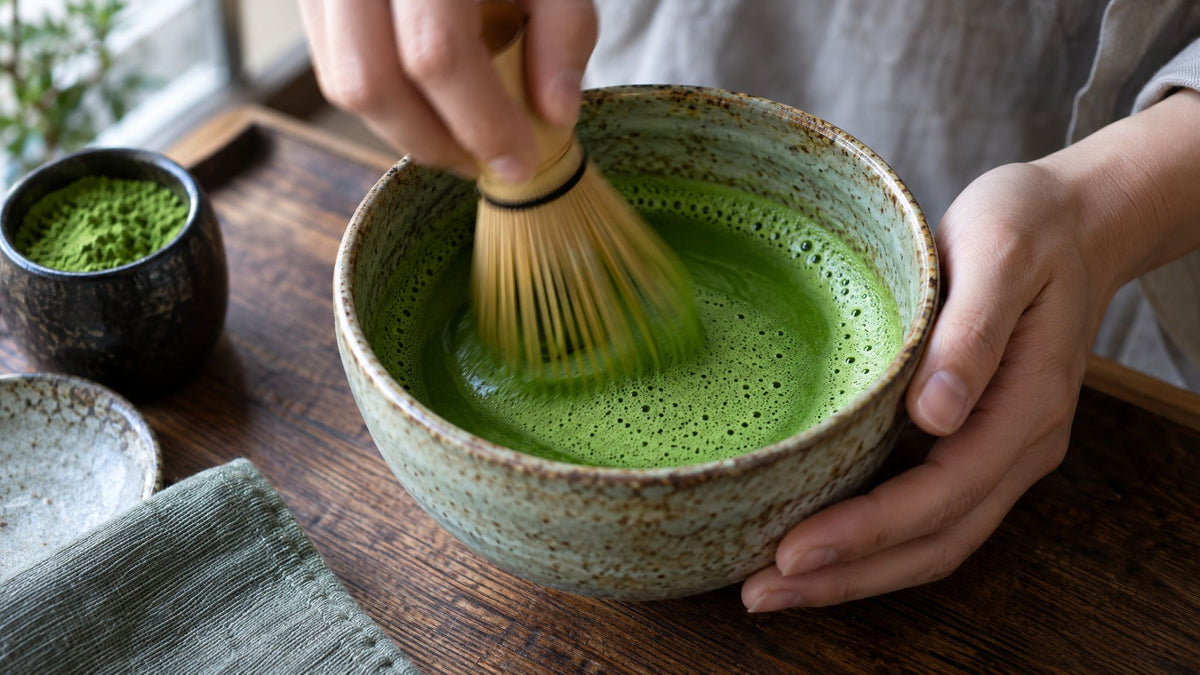
Sift 2 g of matcha into a bowl, add 60 to 70 ml of water at 75 to 80°C, then whisk in a fast M or W motion from the wrist, not in circles, for 15 to 30 seconds until fine foam covers the surface. Lift the whisk out gently from the centre. Soak the chasen in warm water first so the tines bend instead of snapping.
In this guide
Lesson 1: the numbers
No thermometer? Boil the kettle, pour into a cup, then into the bowl. Each pour drops the water about 10°C. Two pours gets you close to 80°C.
Lesson 2: the 60 second method
- Warm the bowl and soak the whiskPour hot water into the bowl and stand the chasen in it for a minute. Soft, damp tines bend instead of snapping.
- Sift the matchaTip out the water, dry the bowl, and sift 2 g of matcha into it. Sifting is the difference between foam and lumps.
- Add the water60 to 70 ml at 75 to 80°C. Boiling water makes matcha bitter.
- Whisk from the wristHold the whisk upright, tines just touching the bottom, and move fast in an M or W shape. Not circles.
- Finish the foamWhen the surface is covered in fine foam, slow down and skim the top to pop big bubbles.
- Lift out from the centreDraw the whisk up slowly from the middle to leave a small peak.
Lesson 3: whisk, frother or shaker?
How fine the foam usually gets with the same 2 g and 70 ml, scored 1 to 5.
Lesson 4: troubleshooting
Lesson 5: choosing a chasen and a bowl
A chasen is carved from a single piece of bamboo, split into fine tines. Most of Japan's traditional chasen come from Takayama in Nara, where whisk making has been handed down for centuries.
Counts are approximate; makers count differently.
- Bowl width: about 11 to 13 cm across, so the whisk has room to move.
- Flat, wide base: the tines need a floor to work against. A narrow mug makes foam almost impossible.
- A spout helps: a bowl with a spout pours neatly into a latte glass.
- Holder: the ceramic stand (kusenaoshi, くせ直し) keeps the tines' shape as it dries.
Lesson 6: caring for your chasen
- Rinse straight after use in warm water. No soap; it lingers in the bamboo.
- Never put it in the dishwasher or leave it soaking for hours.
- Dry it on a holder so air reaches the middle and the tines keep their curve.
- Do not box it while damp. In a humid Australian summer that is how mould starts. Let it dry fully in open air first.
- Replace it when several tines snap or dark spots will not rinse off.
Monthly Google searches in Australia. Peaks in November and December, when whisks become gifts.
Peak month for matcha whisk: Nov. Quietest: Sep.
Google Ads Keyword Planner, Australia, all languages, Google Search. Monthly figures are Google estimates, rounded into ranges.Questions people ask
How do you make matcha with a whisk?
Can I make matcha without a whisk?
What water temperature is best for matcha?
Why won't my matcha foam?
How do I clean a matcha whisk?
How long does a chasen last?
Eric Huang
Tea instructor, Teafy
Eric is a Taiwanese tea instructor who teaches brewing technique. He writes lessons you can follow at the bench: ratios, temperatures, timing and the hand.
Sources
- Teafy brewing guides for Ceremonial Grade and Kyoto Uji
- Nara Prefecture, Takayama chasen (高山茶筌), traditional craft listing
- Google Ads Keyword Planner, Australia, searches October 2025 to September 2026, checked 11 November 2026
We update this page when the numbers change, and date every change here.
Teas in this guide
Keep reading
 The Japanese tea ceremony
 Ceremonial grade matcha
 How to tell good matcha
 Iced matcha latte