
Guide · Buying matcha
How to tell good matcha from bad.
Colour, smell, feel, foam, label, price. Six checks that tell you more than any word on the front of the pack, and the reason some matcha goes yellow.
CChris PillaiFounder, TeafyPublished 11 November 20266 min read
The short answer
High quality matcha is vivid jade green, smells fresh and sweet, feels as fine as talc, and whisks into a fine foam that lasts. The label names the prefecture and the harvest, and the price reflects that first flush tencha cost about twice second flush at the farm gate in 2025 (MAFF). Khaki colour, a flat or hay smell and harsh bitterness up front mean old or low grade powder.
In this guide
The 30 second answer
Why quality shows up in the bowl
You do not need a lab. You need to know how matcha is made. Every test below follows from it.
Japan's agriculture ministry describes the process; the effects are why quality matcha looks, smells and tastes the way it does.
Our tasting notes, scored 1 to 5.
Sweet and savoury first, a soft finish.
Flat, then harsh.
Test 1: colour
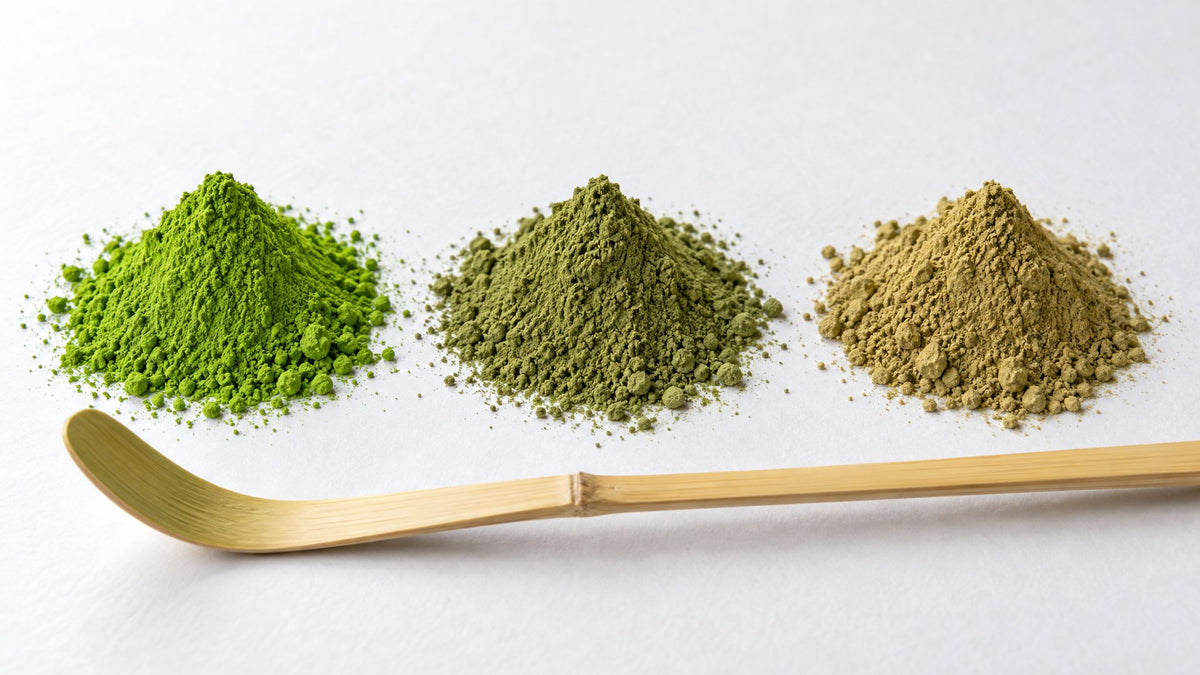
Put a little matcha on white paper in daylight, next to one you know is good. First flush ceremonial is a bright, almost electric jade. Culinary grades from later harvests are deeper and less vivid. That is normal.
What is not normal is khaki or yellow. That means old powder, light and air damage, or coarse late season leaf.
Test 2: aroma and taste
Open the pack and smell it straight away. Good matcha smells fresh and sweet. Sometimes steamed greens, seaweed or cream.
Then whisk 2 g in 60 ml of water at 75°C and taste it plain. Sweetness and savoury depth should come first. Bitterness, if any, only at the end. Bitterness that hits first means late harvest leaf or water that was too hot.
Test 3: texture and foam
Rub a pinch between your fingers. Stone milled ceremonial is extremely fine, about the texture of eyeshadow. It whisks into a fine, even foam that holds for minutes. Big bubbles that pop fast point to coarser milling or older powder.
Test 4: the label
- Country and prefecture. Uji (Kyoto), Shizuoka, Kagoshima, Nishio (Aichi). Japan alone is a start, not an answer.
- Harvest. First flush (ichibancha, 一番茶) for ceremonial.
- Best before date. Six months or more away is a good sign.
- Packaging. A light proof tin or foil pouch. Clear bags let light destroy the colour.
- Testing. A brand that tests for heavy metals and residues will tell you, with numbers.
Test 5: the price
Price is not proof. It is a sense check.
Add milling, sorting, freight, cold storage and testing. A genuine first flush ceremonial matcha cannot be the cheapest powder on the shelf. A ceremonial label at a culinary price is worth questioning.
Test 6: real vs fake matcha
Fake is a strong word. Most cheap matcha is real powdered green tea. The questions are where it grew and how it was made.
- Ground sencha sold as matcha. Unshaded, rolled leaf milled to powder. Duller green, more bitter, grainy. Japan does not call this matcha.
- Matcha from other countries. Legitimate powdered tea, often from China. A different product, not Japanese matcha. Labels must not mislead about origin.
- Blends with fillers. Latte mixes with sugar, milk powder or flavour. Check the ingredients line says green tea only.
Why matcha goes dull, yellow or brown
Chlorophyll and fresh aromas break down with light, heat, oxygen and moisture. A pack left open on a sunny bench can lose its colour in weeks. Keep it sealed, cool and dark. Finish an opened pack within about a month.
Monthly Google searches in Australia. Interest in quality, not just matcha, has climbed sharply through 2026.
Peak month for high quality matcha: May. Quietest: Sep.
Google Ads Keyword Planner, Australia, all languages, Google Search. Monthly figures are Google estimates, rounded into ranges.Questions people ask
How can you tell if matcha is high quality?
How can you tell if matcha is real?
Why is my matcha yellowish?
Should matcha smell like anything?
Is bitter matcha bad?
Does good matcha have to be expensive?
Chris Pillai
Founder, Teafy
Chris founded Teafy to bring Japanese tea from the farm to Australian cups with nothing lost on the way. He writes the buying guides: prices, labels, and what is worth paying for.
Sources
- Ministry of Agriculture, Forestry and Fisheries (MAFF), 茶をめぐる情勢, October 2026
- MEXT Food Composition Database, matcha (16035)
- ABC News, matcha labelling in Australia, 13 December 2025
- Teafy heavy metal lab report 485468, Agrifood Technology, NATA accreditation 2726, April 2026
- Google Ads Keyword Planner, Australia, searches October 2025 to September 2026, checked 11 November 2026
We update this page when the numbers change, and date every change here.
Teas in this guide
Keep reading
 Ceremonial grade matcha
 Japanese vs Chinese matcha
 How to store matcha
 Where to buy matcha in Australia