
Explainer · Buying matcha
Japanese vs Chinese matcha.
Matcha is made in both countries, and plenty of Australian cafes have quietly switched. What actually differs, what it costs, and how to tell which one you are buying.
LLauren PollockOperations manager, TeafyPublished 11 November 20265 min read
The short answer
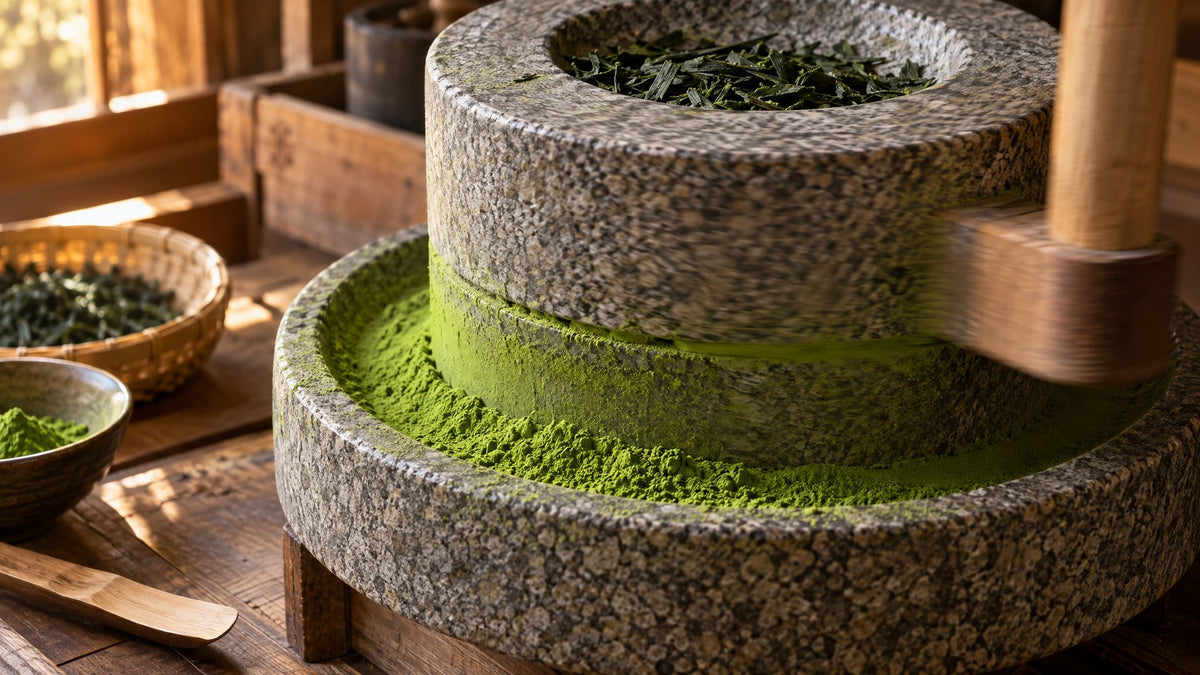
Matcha is made in both Japan and China. Japanese matcha is milled from tencha, shaded tea leaf from regions such as Uji, Shizuoka and Kagoshima, and costs more. Chinese matcha style powders are usually cheaper and vary widely. Neither is fake if it is labelled honestly; the problem is labels that hide origin. In Australia the word matcha itself is not protected, but origin claims must not mislead.
In this guide
What you need to know
- Origin is not a quality score on its own. There are poor Japanese powders and decent Chinese ones.
- But they are different products. Japanese matcha has a supply chain built around shading, tencha drying and slow milling.
- If it says Japanese, it must be Japanese. Origin claims fall under the Australian Consumer Law.
- The label is your only tool. Look for the country, the prefecture and the harvest.
How each is made
Our tasting notes, scored 1 to 5. Individual products vary widely.
Sweet, savoury, bright.
Grassier, more drying.
The price gap, in real numbers
SBS News reported in October 2025 that a Melbourne cafe owner was paying nearly four times as much for Japanese matcha as for tier three Chinese matcha of a similar grade. That gap is why many cafes have switched.
The flow is not one way. Japan itself imported 82% more green tea in fiscal 2025, 5,801 t in total (The Japan Times, May 2026).
Myth and fact
What Australian labels must and must not say
- No misleading origin. Under the Australian Consumer Law a business must not mislead you about where a product comes from. A Chinese powder sold with Japanese imagery and the word Uji would be a problem.
- Matcha is not a protected word. ABC News reported in December 2025 that matcha labelling is almost completely unregulated, and that while Uji matcha can be trademarked, matcha cannot.
- No specific enforcement yet. We found no ACCC or food regulator action specific to matcha origin claims from 2024 to 2026. Your best protection is a clear label.
What Uji, Shizuoka and Kagoshima should mean
A five step label check
- Find the country of originIt should say Japan, not just show Mount Fuji.
- Look for a prefectureUji, Shizuoka, Kagoshima, Nishio and so on.
- Check the harvestFirst flush for ceremonial.
- Compare the priceJapanese first flush ceremonial cannot be very cheap in 2026.
- AskA good seller answers where it is from, quickly and specifically.
Monthly Google searches in Australia.
Peak month for japanese matcha: Mar. Quietest: Sep.
Google Ads Keyword Planner, Australia, all languages, Google Search. Monthly figures are Google estimates, rounded into ranges.Questions people ask
Is Chinese matcha real matcha?
What is the difference between Japanese and Chinese matcha?
Is Chinese matcha safe?
How can I tell if my matcha is from Japan?
Why do cafes use Chinese matcha?
Lauren Pollock
Operations manager, Teafy
Lauren is the operations manager at Teafy. She writes the explainers and comparisons, the side by side pages that settle a question in a few minutes.
Sources
- SBS News, Australian matcha demand and cafe prices, 25 October 2025
- ABC News, matcha labelling in Australia, 13 December 2025
- The Japan Times, Green tea exports, 1 May 2026
- ACCC, Country of origin claims under the Australian Consumer Law
- Ministry of Agriculture, Forestry and Fisheries (MAFF), 茶をめぐる情勢, October 2026
- Google Ads Keyword Planner, Australia, searches October 2025 to September 2026, checked 11 November 2026
We update this page when the numbers change, and date every change here.
Teas in this guide
Keep reading
 The matcha shortage, explained
 Where to buy matcha in Australia
 How to tell good matcha
 Uji, Shizuoka and Kagoshima