
Guide · Matcha
Matcha, explained.
What legally makes a powder matcha, what weeks in the shade do to the leaf, why the mill matters, and how to whisk a bowl that tastes sweet rather than bitter.
The short answer
What is matcha?
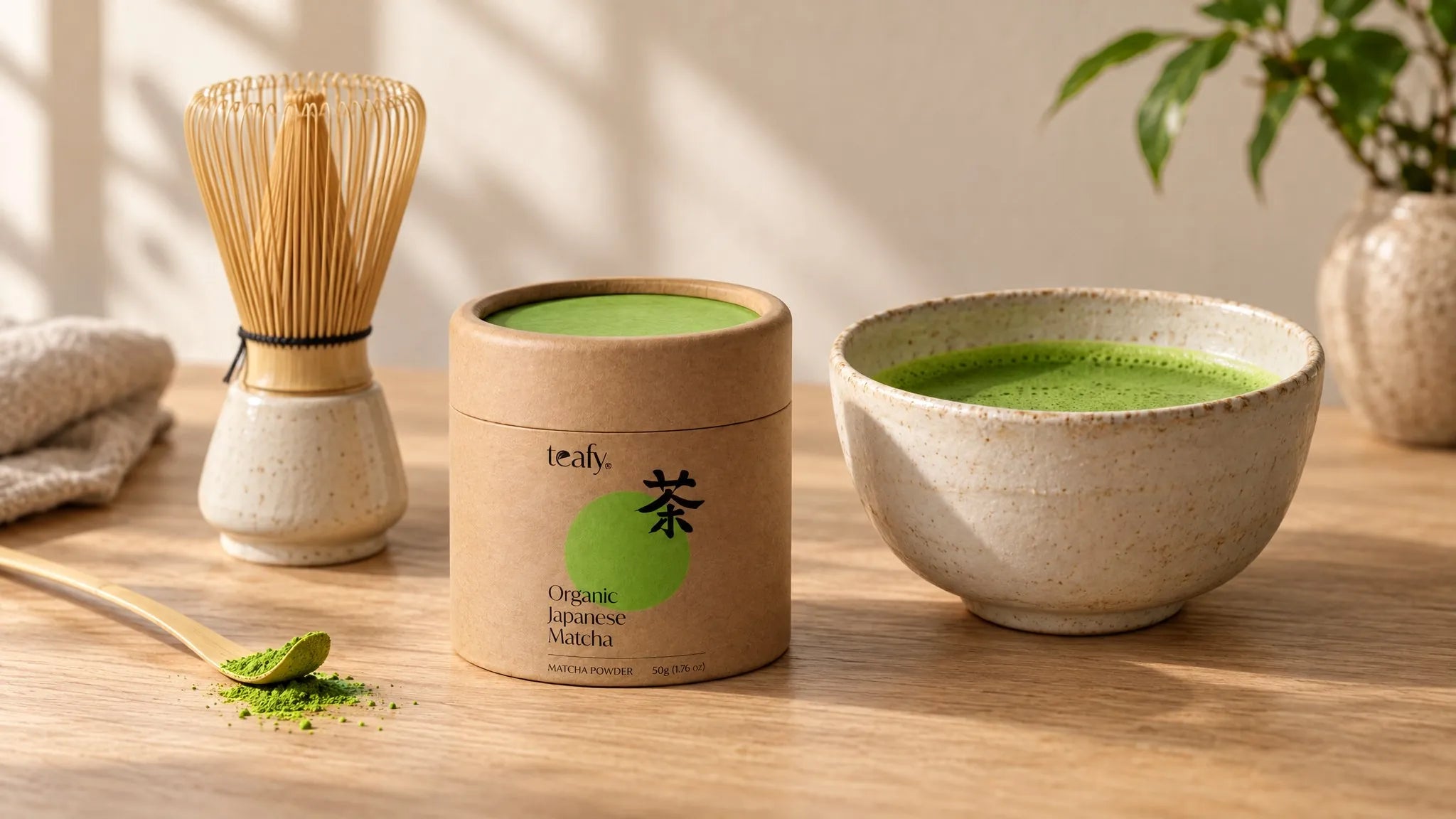
Matcha (抹茶) is Japanese green tea leaf that is shaded before picking, steamed, dried flat, then milled into a fine powder that you whisk and drink whole.
That last part is the difference. With sencha you steep the leaf and throw it away. With matcha you drink the leaf itself, which is why the colour, the body and the caffeine are all stronger.
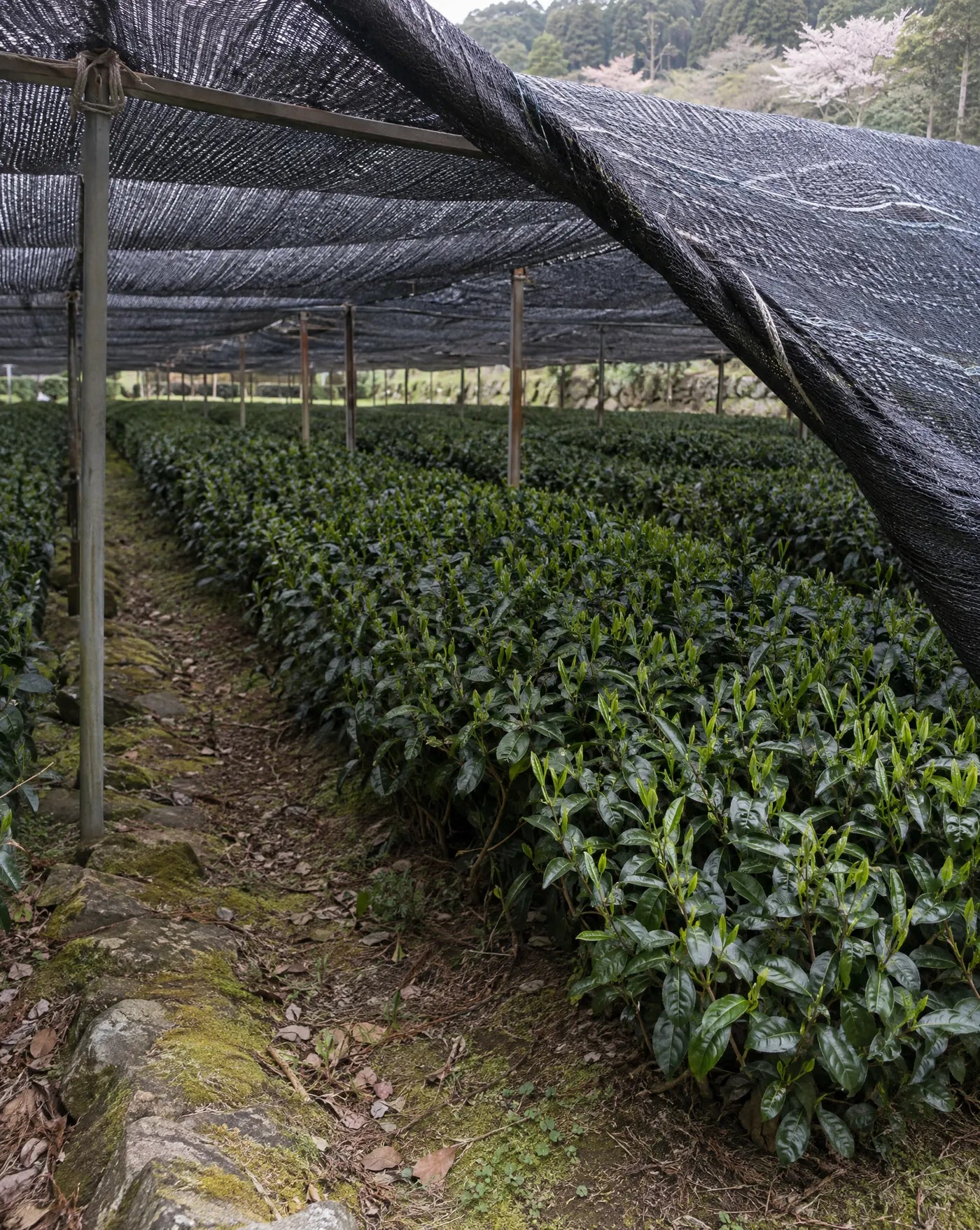
- Shaded. Two to three weeks under cover before the spring harvest.
- Steamed. To stop the leaf browning, like all Japanese green tea.
- Dried flat. Never rolled. This leaf is called tencha.
- Stems and veins out. Only the soft leaf blade goes to the mill.
- Milled. Ground to particles of 1 to 20 µm, finer than flour.
The four rules that make it matcha.
Japan's tea industry labelling standard and the international ISO definition agree on four things. A powder that misses one is not matcha, whatever the packet says.
Shade grown
Covered with reed screens, straw or cloth for about two to three weeks before picking.
Steamed
Heat stops the enzymes that brown the leaf, keeping the green.
Not rolled
Dried flat. Rolled leaf is sencha or gyokuro, not tencha.
Finely milled
Ground to powder. Japan's standard allows leaf only.
Interactive · Drag the days
Under the shade: what the dark does to the leaf.
Drag the handle to cover the tea bushes for longer. The bars are real measurements from a shading trial at Shizuoka's Tea Research Center, on leaf covered with 85% shade cloth.
Grown in full sun
This is how most sencha is grown. The leaf makes plenty of catechins, the compounds behind green tea's bite, and stays a lighter, yellower green.
Drag the handle, tap a day, or swipe across the garden.
Suzuki, Yamamoto, Katai and Kamiya, Shizuoka Prefectural Research Institute of Agriculture and Forestry, 2009 trial, cultivar Tsuyuhikari, crude tea. Leaf greenness and the catechin fall were statistically significant; the theanine and caffeine changes in this short trial were not. The trial stopped at 12 days. Longer shading studies find the same direction: greener leaf, fewer catechins, more theanine and caffeine.
Leaf to powder
Tencha first, then the mill.
Tencha
Dried flat, picked clean.
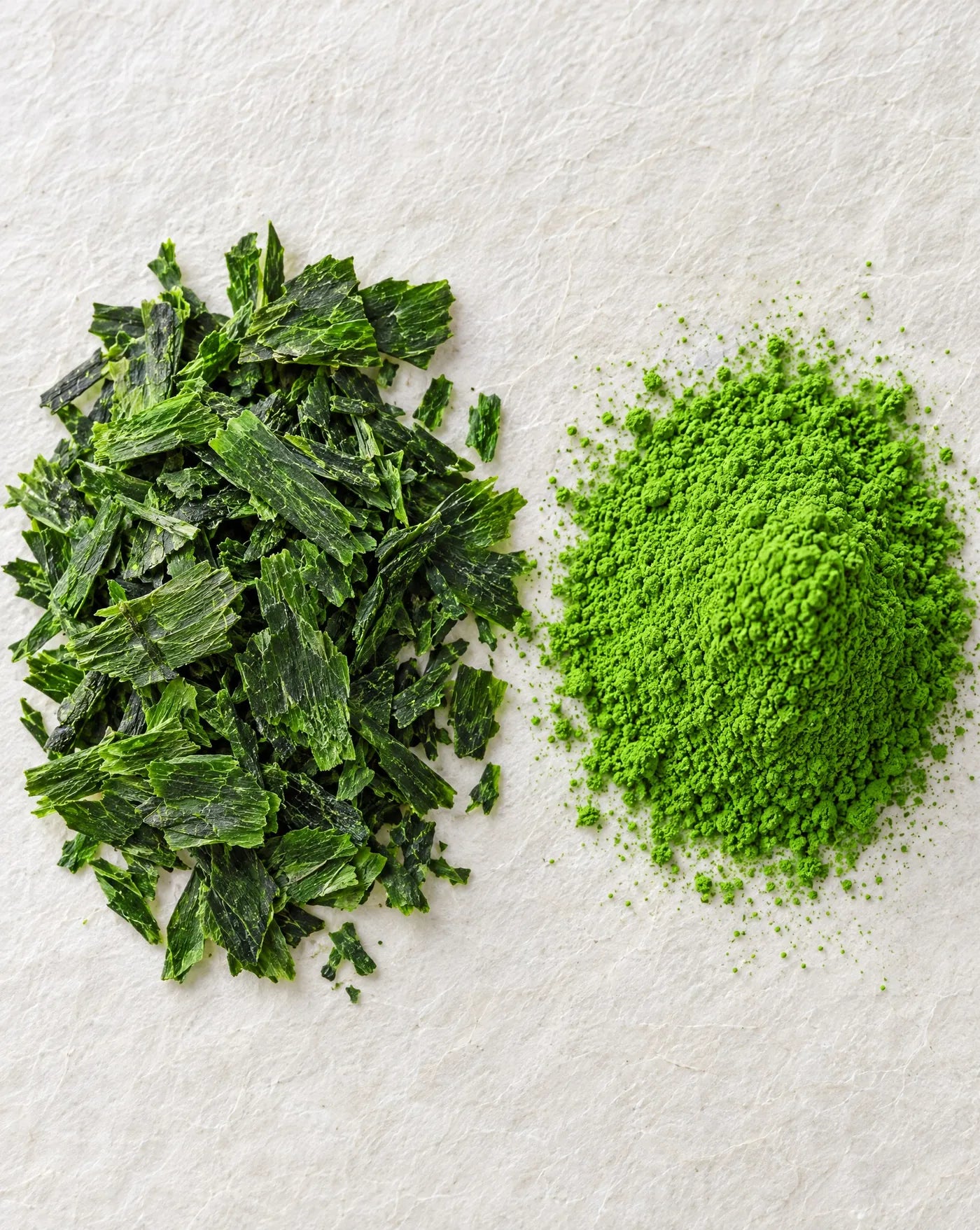
Shaded leaf is steamed soon after picking, then dried flat in a tall brick dryer instead of being rolled. What comes out is tencha: flat, papery flakes. The stems and veins are then sorted out, because they mill pale and taste thin.
Tencha is rarely drunk as it is. Almost all of it goes to the mill, and Japan's tea farms now make far more of it than they did a decade ago.
The mill
Slow on purpose.
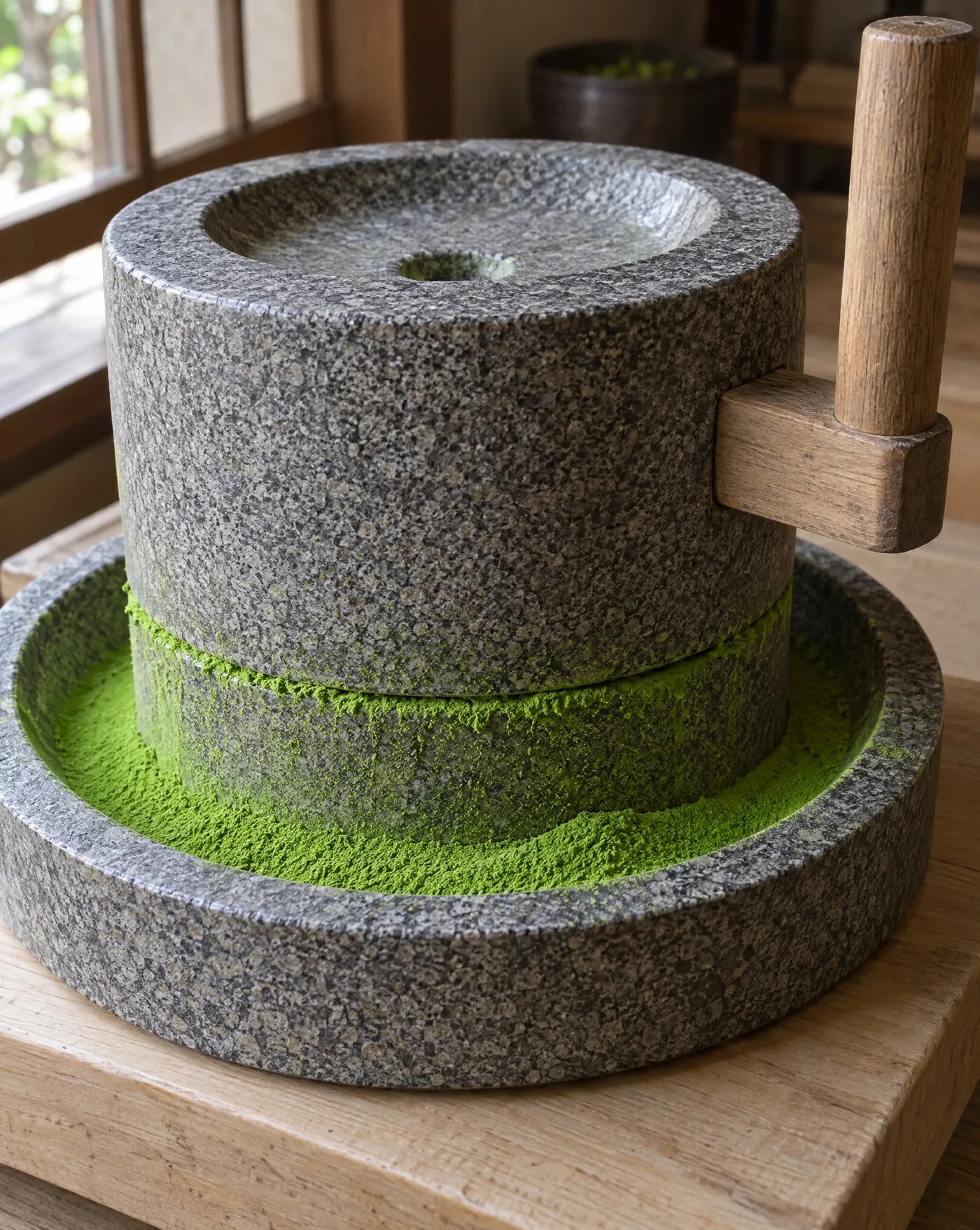
Japan's agriculture ministry describes matcha as tencha milled with a stone mill or similar to particles of 1 to 20 µm. A granite stone mill is slow: our Kyoto Uji page gives about 40 g an hour. Going faster makes heat, and heat dulls the colour and aroma.
Faster mills exist. Our Superior Culinary is bead milled to a coarser 1,500 to 2,000 mesh, because a latte needs body more than finesse. Our Ceremonial is milled to 3,000 to 3,500 mesh and Kyoto Uji to 3,500 to 4,000, as our product pages state.
Grades, honestly
Ceremonial is a trade word, not a law.
Japan's standard and ISO define what matcha is. Neither sets grades. Any brand can print ceremonial on a packet, so the useful questions are which harvest, how long it was shaded, how it was milled and what it is for. Here are ours, side by side.
From our product pages. Okumidori is a late budding cultivar; Nagasaki's tea research station found it suited long shading for tencha.
Matcha in numbers
Japan is making more tencha than ever.
Japan's tencha output
Tonnes of crude tencha, the leaf for matcha.
MAFF and the National Tea Producers' Federation. Japan's agriculture ministry puts 2025 output at about 3.2 times 2014. By prefecture in 2023: Kagoshima 38%, Kyoto 23%, Shizuoka 12%, all others 27%.
Caffeine in one serve
Milligrams. Matcha at Japan's official 3.2 g per 100 g of powder.
Food Safety Commission of Japan. Figures marked ~ are worked out from its per gram and per 100 ml values. Teafy Ceremonial is stated at 60 to 70 mg per 2 g.
What tea tasters look for
How to judge a matcha.
Colour is the first test, and not just by tradition. Researchers at Aichi's agricultural research centre scanned tencha leaf and powder over three seasons: the greener the hue, the higher the tasters' scores, and the powder's colour tracked its total nitrogen.
- ColourVivid, deep spring green. Olive, khaki or yellow means older leaf, a later harvest or poor storage.
- TextureSo fine it clings to the sieve and feels like silk between your fingers. Grit means a coarse grind.
- AromaFresh and sweet, often with a nori like note Japanese tasters call ooika, the aroma of covered tea. Hay or dust means stale.
- FoamWhisked as usucha, a fine, even foam of tiny bubbles that lasts. Big bubbles that collapse point to coarse or old powder.
- TasteSweet and savoury first, a light grip after. Bitterness that lingers is hot water, too much powder or tired matcha.
- FinishGood matcha leaves a long, clean, slightly sweet aftertaste.
Japan's standard allows only shaded, unrolled, milled leaf to be called matcha. Powdered tea made from ordinary sencha is a cheaper product sold as green tea powder. If a packet does not say where or how the leaf was grown, ask.
Two ways to drink it
Usucha and koicha.
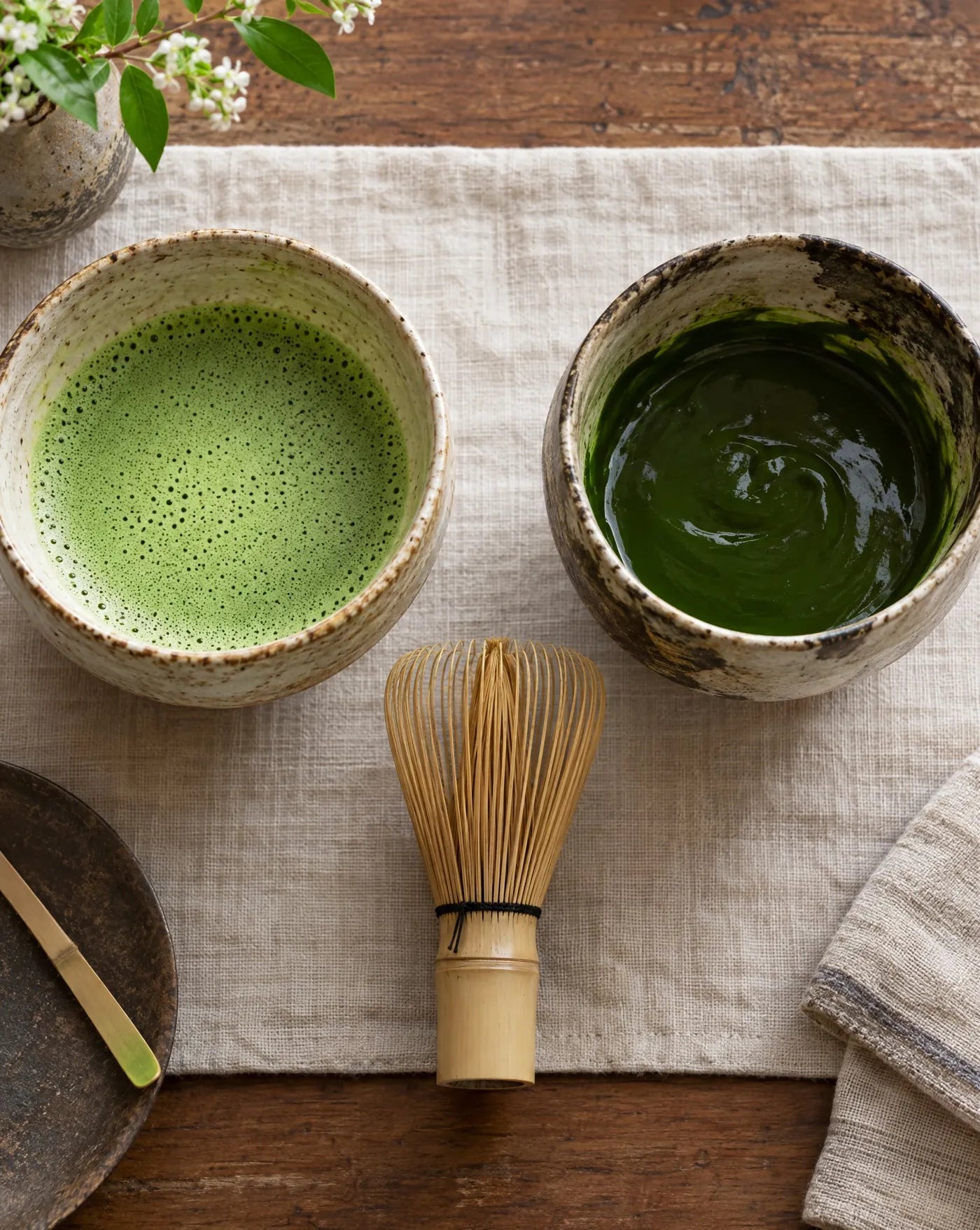
Thin and thick
Same powder, very different bowl.
Usucha, thin tea, is the bowl most people know: about 2 g in 60 ml, whisked briskly in an M shape until a fine foam covers the top.
Koicha, thick tea, uses about 4 g in 30 ml, kneaded slowly with the whisk so it turns glossy, with the texture of warm honey and no foam. It is made only with the best leaf, because there is nothing to hide behind. Our Kyoto Uji is made for both.
Make it at home
How to make matcha.
Sift first, keep the water under 80 °C, and whisk fast. Those three things fix nearly every bitter, lumpy bowl.
Usucha
- Matcha2 g, sifted
- Water60 ml at 70 to 80 °C
- WhiskM shape, about a minute
- DrinkWithin 15 minutes
Kyoto Uji likes the cool end, 70 °C. Lift the whisk out slowly through the centre.
Latte
- Matcha3 g, sifted
- Water40 ml at 75 °C
- WhiskUntil it froths
- Milk150 ml, hot or iced
Whisk the matcha into a paste with water first, then add milk. That step is what stops clumps.
Koicha
- Matcha4 g, sifted
- Water30 ml at about 70 °C
- WhiskKnead slowly, no foam
- LeafKyoto Uji
Add half the water, knead to a paste, then the rest. Glossy and smooth is the goal.
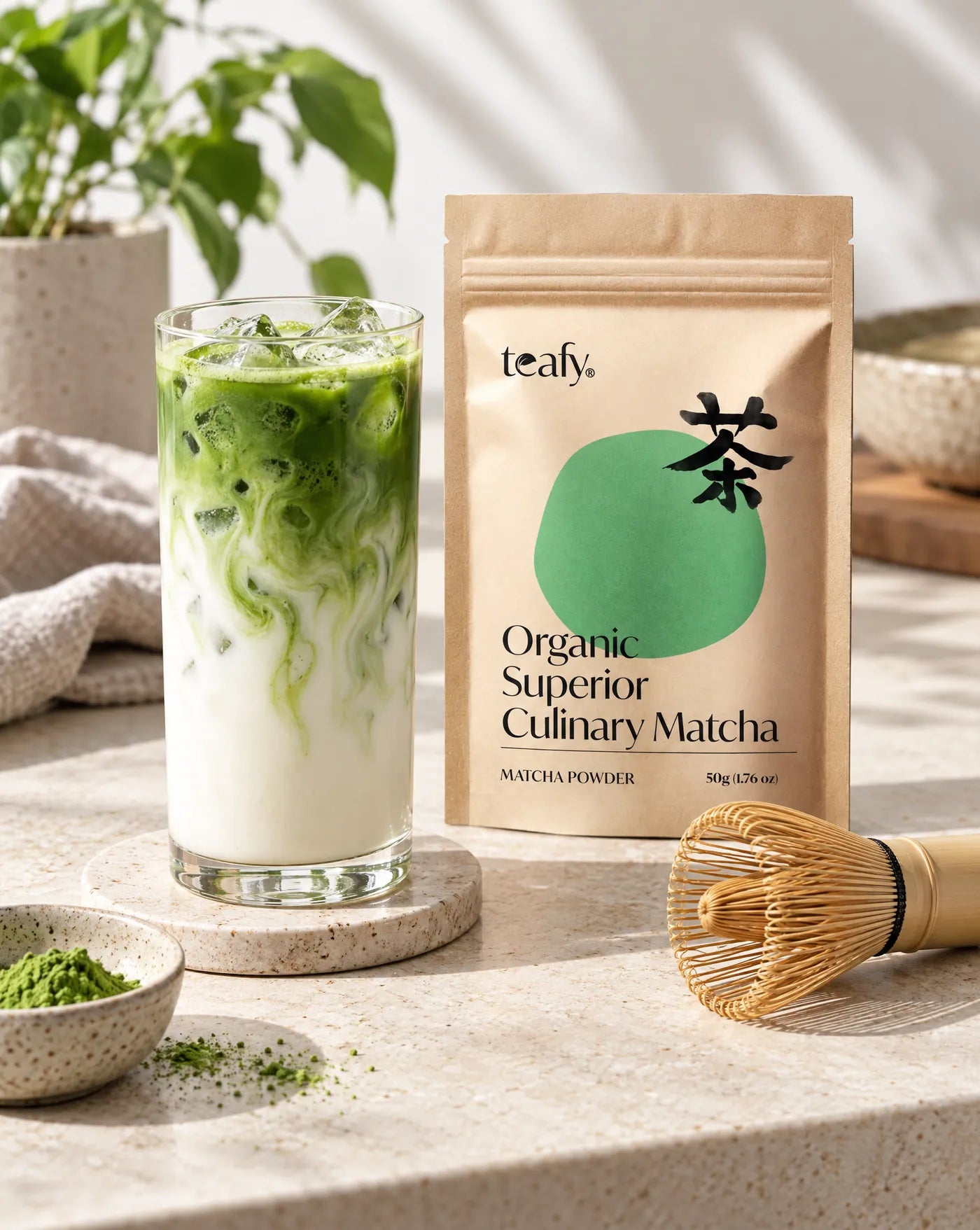
Iced
The easy iced latte.
Whisk 3 to 4 g of Superior Culinary with 40 ml of water at 75 °C, pour over ice and 150 ml of cold milk, then stir. Culinary grade is built to hold its colour and flavour in milk.
Keep opened matcha sealed in the fridge and finish it within about 30 days. Ours waits in a 0 to 4 °C cold room in Melbourne until it ships.
Teafy matcha
Three matchas, three jobs.
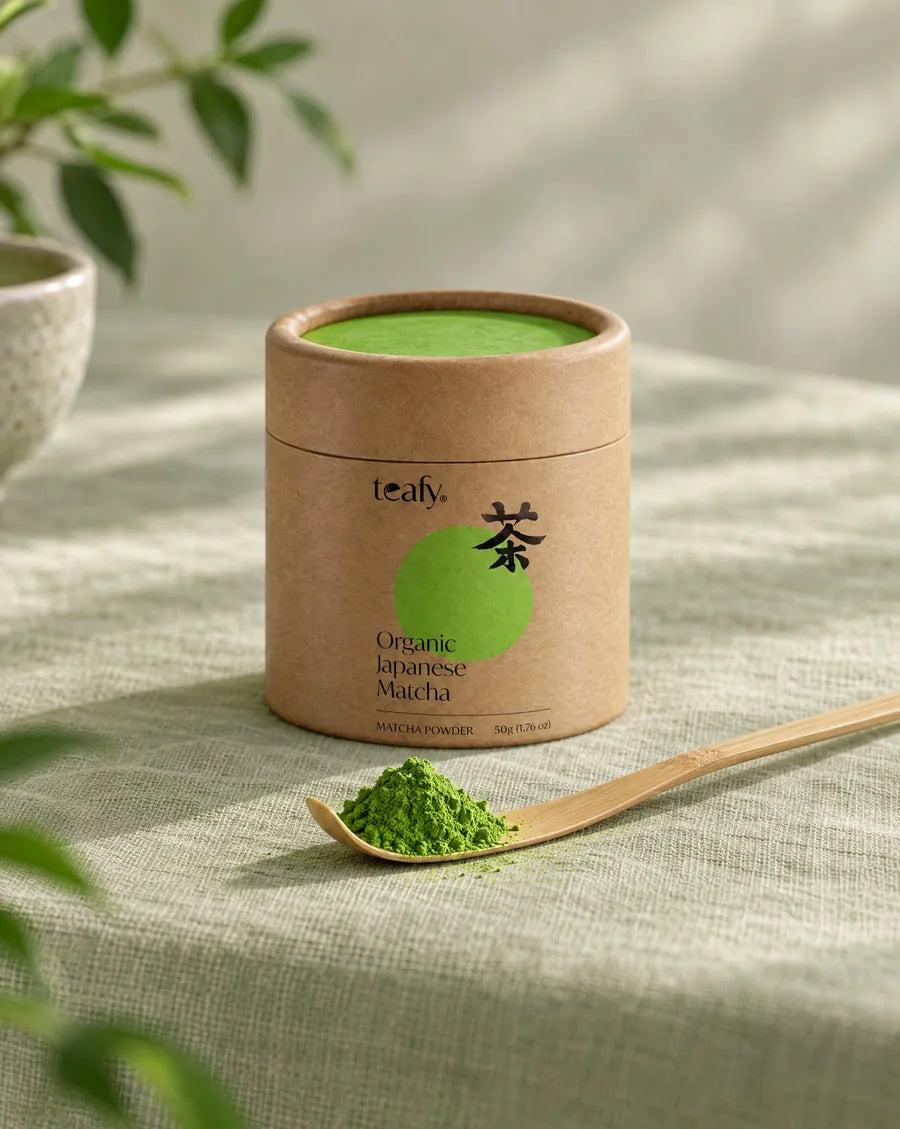
Ceremonial Grade
From our family farm in Shizuoka, shaded 25 days. Creamy, soft and made for every day. 50 g, about 25 bowls.
Pouch $31.99 · Can $32.99
Shop Ceremonial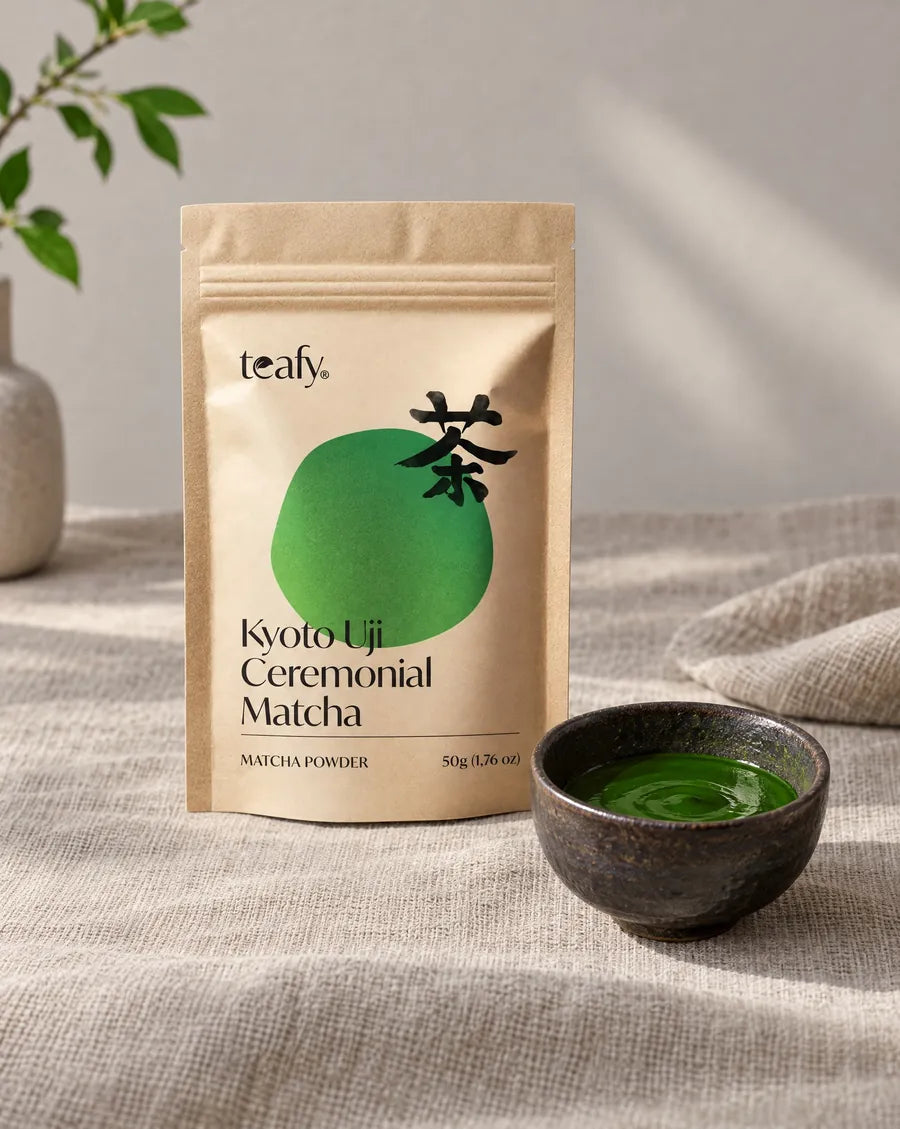
Kyoto Uji
Okumidori from Uji. Our deepest matcha, for whisking straight as usucha or koicha. 50 g, about 25 bowls.
$54.95
Shop Kyoto Uji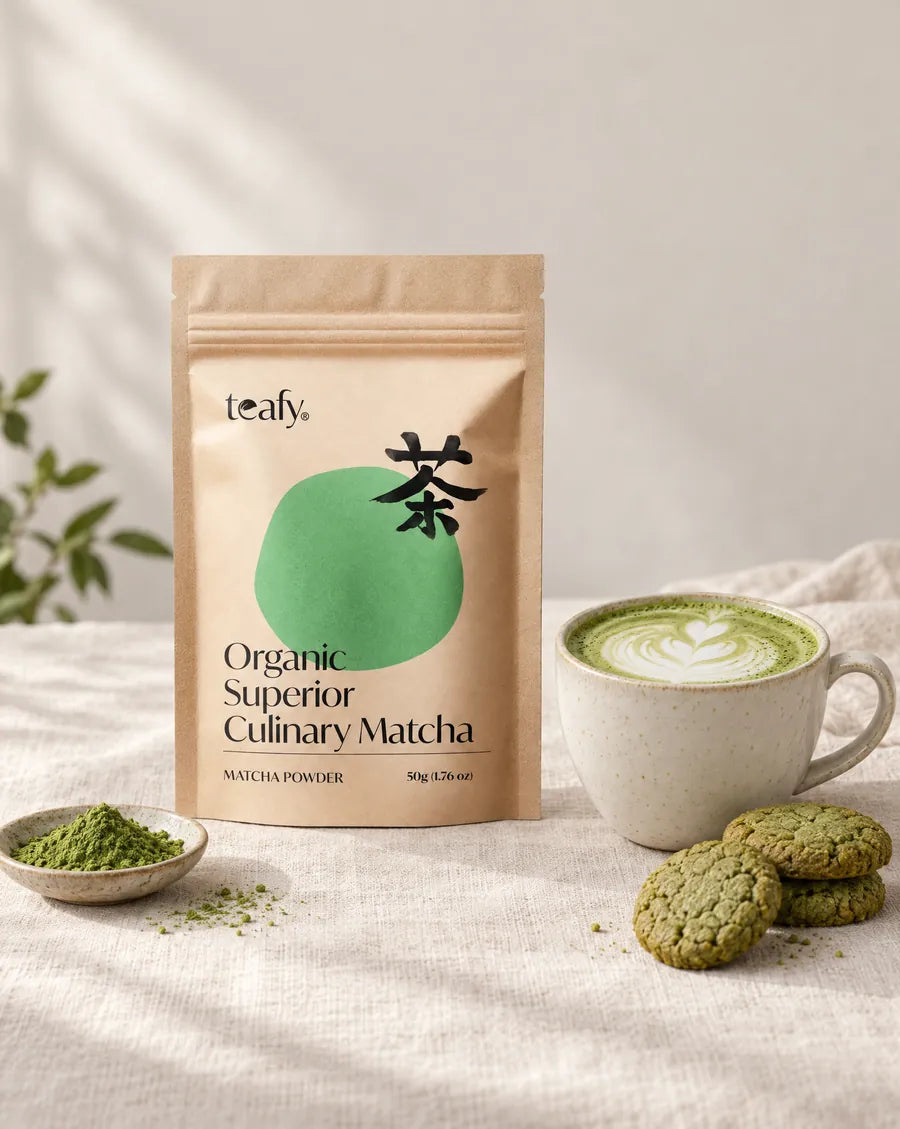
Superior Culinary
Three regions, bead milled for body. Built for lattes, iced drinks and baking. 50 g, about 15 lattes.
$21.99
Shop CulinaryQuestions people ask
Matcha, answered.
Is matcha just ground green tea?
No. Under Japan's labelling standard and the ISO definition, matcha must come from leaf that was shaded before picking, steamed, dried without rolling and then milled. Milling ordinary sencha gives you powdered green tea, which is a different product.
What is the difference between ceremonial and culinary matcha?
There is no official grading. Ceremonial is a trade word for matcha good enough to drink with water alone. Culinary means matcha built to stand up to milk, sugar and heat. Teafy's Superior Culinary blends first and second harvest leaf for body, and is bead milled coarser than our Ceremonial.
How much caffeine is in matcha?
Japan's Food Safety Commission lists matcha at 3.2 g of caffeine per 100 g of powder, or 48 mg in a 1.5 g bowl. A 2 g bowl of Teafy Ceremonial carries about 60 to 70 mg. Koicha uses twice the powder, so roughly twice the caffeine.
Why does my matcha taste bitter?
Usually water that is too hot or too much powder for the water. Keep it at 70 to 80 °C, never boiling, sift the powder and whisk briskly. Matcha that has been open too long also turns flat and bitter.
What is the difference between usucha and koicha?
Usucha is thin tea, whisked to a foam: about 2 g in 60 ml. Koicha is thick tea, kneaded slowly without foam: about 4 g in 30 ml. Koicha is made only with the best leaf because there is nothing to hide behind.
How should I store matcha?
Light, heat, air and moisture fade it. Keep it sealed, cool and dark, refrigerate once opened and finish it within about 30 days for the brightest colour.
Is Teafy matcha stone milled?
Our product pages state that Ceremonial Grade and Kyoto Uji are stone milled on granite mills, at about 40 g an hour for Kyoto Uji, and that Superior Culinary is bead milled to a coarser 1,500 to 2,000 mesh for lattes and baking.
Sources
Where these facts come from.
- Japan Tea Central Public Interest Incorporated Association. Green tea labelling standard (March 2019): tencha from gardens covered for about two to three weeks, as cited by Nagasaki Prefecture's tea research station. Source
- ISO/TR 21380:2022 Matcha tea: definition and characteristics, and ISO 20715:2023 Tea: classification of tea types. Source
- Ministry of Agriculture, Forestry and Fisheries. Japanese tea types for export: tencha is steamed and dried without rolling, then milled to 1 to 20 µm. Source
- Suzuki Y., Yamamoto K., Katai H. and Kamiya K. Effects of covering in tea cultivar Tsuyuhikari. Shizuoka Prefectural Research Institute of Agriculture and Forestry, Tea Research Center (2009 trial). World Green Tea Association conference proceedings, 2010. Source
- Sano T. and others (2018). Covering culture decreased epicatechin and epigallocatechin and increased theanine and caffeine. Journal of Plant Research, via MEDLINE. Source
- Ministry of Agriculture, Forestry and Fisheries (2026). The tea situation: tencha output up about 3.2 times on 2014; Kagoshima the largest tencha producer. Source
- Ministry of Agriculture, Forestry and Fisheries (2023). Tencha output by prefecture: Kagoshima 38%, Kyoto 23%, Shizuoka 12%. Source
- Aichi Prefecture (2025), citing the National Tea Producers' Federation: 5,336 t of tencha in 2024. Source
- Ryutsu Keizai University (2022), citing MAFF: tencha output 1,480 t in 2009 and 2,736 t in 2020; 61% of 2020 green tea export value was powdered tea. Source
- National Agriculture and Food Research Organization (2025). Green tea exports about 36.4 billion yen in 2024, 4.7 times 2014. Source
- Food Safety Commission of Japan (2018). Caffeine fact sheet: matcha 3.2 g per 100 g, 48 mg in a 1.5 g bowl. Source
- Tsuji H., Omizu H. and Shirai K. (2020). Relationship between the colour and quality of tencha. Research Bulletin of the Aichi Agricultural Research Center 52, 185 to 188. Source
- Nippon.com Japan Data. Types of Japanese tea: shaded teas, the nori like covered aroma, and tencha with stems and veins removed. Source
- Teafy Ceremonial Grade, Kyoto Uji Ceremonial and Superior Culinary matcha: origin, shade days, milling, mesh, caffeine and brewing. Source