Guide · caffeine, dose, feel and cost

Matchavscoffee.

Gram for gram, serve for serve, hour by hour. What is actually in each cup, why a bowl at 10 am does not feel like an espresso at 10 am, and which one to drink when.

Updated 9 October 2026
Figures from USDA, FSANZ, published trials and the Teafy product pages
Every source is listed at the end
An espresso cup beside a bowl of freshly whisked matcha on a travertine benchSingle espresso, 7 to 9 g of beansCeremonial bowl, 2 g of leaf

1. The weigh in

How much caffeine, by the gram.

Matcha has less caffeine than coffee per serve, but not dramatically less, and anyone who calls matcha a low caffeine drink is selling something. The dose is what decides it. Here is every common serve with the grams that go into it.

Matcha bowl
60 to 70mg
2 g Teafy Ceremonial, 70 ml water
The standard usucha bowl. One heaped chashaku scoop.
Matcha bowl, strong
120 to 140mg
4 g Teafy Ceremonial
Two scoops, or a koicha style thick bowl. Same as a double shot.
Matcha latte
90 to 105mg
3 g matcha, 150 ml milk
The usual café dose. Some cafés use 4 g.
Hojicha
16 to 30mg
2 g Teafy Hojicha Powder
The after 3 pm cup. Roasting drops the caffeine.
Single espresso
60 to 75mg
7 to 9 g of beans, 30 ml
USDA restaurant espresso averages about 63 mg a shot.
Double espresso
125 to 150mg
16 to 20 g of beans, 60 ml
What most Melbourne flat whites and long blacks are built on.
Brewed coffee
about 95mg
10 to 15 g of beans, 240 ml
Filter, plunger or pour over. USDA Standard Reference.
Large flat white
125 to 150mg
Double shot, 350 ml milk
The one that is still in your system at bedtime.
About 30 to 35 mg a gramMatcha, by the gram of powder. You drink the whole ground leaf, so what is in the leaf is in you. Double the scoop and you double the dose: a 4 g bowl is level with a double espresso.
About 7 to 9 mg a gramCoffee, by the gram of beans that ends up in the cup. Water passes through the grounds and takes most of the caffeine but not all. A single shot is 7 to 9 g of beans, a modern double 16 to 20 g.
Everything on one ruler
0 mg25 mg50 mg75 mg100 mg125 mg150 mgHojicha 2 gMatcha bowl 2 gMatcha latte 3 gMatcha bowl 4 gSingle espressoBrewed coffeeDouble espresso, flat white
Matcha bowl 2 gHojicha 2 gMatcha latte 3 gMatcha bowl 4 gSingle espressoBrewed coffeeDouble espresso0255075100125150mg of caffeine a serve

Green dots are matcha and hojicha from the Teafy product pages, brown dots are coffee from the USDA database and common espresso doses. The midpoint of each range is plotted.

Matcha and hojicha figures are from the Teafy product pages. Coffee figures are the USDA Standard Reference for brewed coffee (about 95 mg a 240 ml cup) and restaurant espresso (about 63 mg a 30 ml shot). Espresso doses are the common industry range; the café, the roast and the barista move every coffee number. Treat all of these as ranges, not lab results.

2. Why they feel different

Same caffeine, different ride.

If caffeine were the whole story, a 2 g bowl and a single espresso would feel the same. Most people say they do not. Two things explain it, and both have evidence behind them.

L theanine. An amino acid found in tea and barely anywhere else, and in shaded tea like matcha at much higher levels, because shading stops the plant converting it into catechins. Three randomised trials from the same research group gave adults caffeine with and without L theanine and measured attention, alertness and distraction. The combination did better than caffeine alone on attention switching and accuracy, and reduced self rated tiredness, without the same rise in jitteriness.

The effect sizes are modest, the doses were capsules rather than matcha, and nobody has run the trial with a bowl of Teafy. But the mechanism is real and it matches what many regular drinkers describe.

Acid. Coffee is acidic and matcha is not. A lot of what people call coffee jitters is a stomach reaction to black coffee on an empty stomach rather than the caffeine itself. Matcha is mild on the stomach, which is why people who cannot drink coffee before food can usually drink a bowl of matcha.

There is a third, slower reason. Matcha's caffeine is bound in leaf matter that your gut releases over time, where coffee's caffeine is already dissolved and arrives at once. That is why the curve below has the shape it has.

What actually ends up in the cup
Grounds stay behind. You drink the water.CoffeeHot water passes through 7 to 20 g of ground beans and carries most of the caffeine out. The chlorogenic acids come with it; the fibre and most of the solids do not.
Nothing stays behind. You drink the leaf.Matcha2 to 4 g of stone ground or bead milled leaf is suspended in water and drunk whole. Caffeine, L theanine, catechins and fibre all arrive together, which is part of why it releases slower.
2008
Owen, Parnell, De Bruin, Rycroft50 mg caffeine with 100 mg L theanine improved accuracy on an attention switching task and reduced susceptibility to distraction, beyond caffeine alone.Nutritional Neuroscience, randomised crossover, 27 adults
2010
Giesbrecht, Rycroft, Rowson, De BruinThe combination improved attention and alertness and reduced self rated tiredness compared with placebo.Nutritional Neuroscience, randomised crossover, 44 adults
2010
Einöther, Martens, Rycroft, De BruinL theanine and caffeine improved task switching, but not intersensory attention or subjective alertness. The honest one: the effect is on focus, not on feeling awake.Appetite, randomised crossover
Coffee gives you caffeine. Matcha gives you caffeine with its hand on the brake.

3. The four hour curve

Fast and gone, or slow and still there.

Draw the two drinks over a morning and the shape is the difference. Coffee arrives fast and leaves fast. Matcha arrives slower and holds longer. A coffee at 7 is gone by 9, which is why the second one happens. A bowl at 7 is still there at 10.

01 h2 h3 h4 halert Coffee peaks earlyMatcha holds
Brewed coffee, about 95 mgMatcha, 60 to 70 mg with L theanine
Illustrative, not measured. Drawn from how the two are commonly described and from the trial results above, where the caffeine and L theanine combination improved attention over caffeine alone without the same rise in jitteriness. Your own curve depends on dose, food, sleep and tolerance.

4. Face off

Side by side, no winner declared.

Coffee
versus
Matcha
About 95 mg a 240 ml brewed cup. 60 to 75 a single shot, 125 to 150 a double
Caffeine a serve
60 to 70 mg a 2 g bowl. 120 to 140 a 4 g bowl. 90 to 105 in a 3 g latte
7 to 9 g of beans a single shot, 16 to 20 a double, 10 to 15 for a brewed cup
Grams in the cup
2 g for a bowl, 3 g for a latte, 4 g for a strong bowl
None
L theanine
High in shaded ceremonial, very high in Kyoto Uji
Fast, 15 to 45 minutes, then a drop
Onset
Slower, smoother, holds longer
Acidic. Hard on an empty stomach for some
Stomach
Mild. Fine before food
Chlorogenic acids
Antioxidants
Catechins including EGCG, and you drink the whole leaf
Water that has passed through grounds
What you drink
The ground leaf itself, suspended
Machine, pod, plunger or pour over
Preparation
Sift, 70 ml water at 75 to 80 degrees, 30 second whisk
Roasted, bitter, acidic, body from the roast
Taste
Umami, sweet, vegetal, creamy if shaded well
50 cents to $1.50 at home for beans, pods higher. $5 to $6 at a café
Cost a cup
$1.32 from the $32.99 Teafy can, $1.15 from the refill bundle. $6 to $7 at a café
Caffeine from USDA and the Teafy product pages. Café prices are typical Melbourne prices in 2026, not a survey. Onset and feel are how the drinks are commonly described and what the L theanine trials point to, not measurements.

5. Which one, when

Nobody needs to give up coffee.

This is not that article. Keep the one you love. Swap the one that does the damage.

7 am
Whichever you love

If the first coffee of the day is a ritual, keep it. Nothing here is improved by giving up something you enjoy. If you want the slower start, make the bowl the first thing instead and notice whether you reach for a second anything by 10.

10 am
Until 2 pm: this is the swap

The second coffee lands on top of the first, it is often bigger, and it is the one still in your system at bedtime. Replace it with a 2 g bowl or a 3 g latte. You keep most of the caffeine, you lose the spike, and you add the L theanine.

After 3 pm
Neither, or hojicha

Caffeine has a half life of about five hours in most adults. A coffee at 4 pm is half still there at 9. A bowl of matcha at 4 pm is the same problem in a nicer cup. The afternoon cup is hojicha, 16 to 30 mg a serve.

Training
Either, by feel

Coffee if you want the sharp hit. Matcha if you want it even. Both work. Matcha has the small advantage of being easy on the stomach, which matters if you are running.

Why 3 pm is the cut off: what is left of a 7 am cup
7 am
95 mg
65 mg
12 pm
48 mg
33 mg
5 pm
24 mg
16 mg
10 pm
12 mg
8 mg

Caffeine halves roughly every five hours in most adults, so the brown bar is a 95 mg brewed coffee drunk at 7 am and the green bar a 65 mg bowl. Both are near zero by bedtime. Drink either at 4 pm and the 10 pm number is the 5 pm number above. Half life varies from about three to seven hours by person, pregnancy and medication.

6. What it costs

Close at the café. Not close at home.

At the café
$5 to $7a cup

A flat white is five to six dollars in Melbourne, a matcha latte six to seven. The two are close. Typical 2026 prices, not a survey.

Coffee at home
50c to $1.50a cup

Good beans, depending on how good and how you brew. Pods run higher. Plus the machine, the grinder and the cleaning.

Matcha at home
$1.32a bowl

Teafy Ceremonial Grade from the $32.99 can, or $1.15 from the five pouch refill. No machine. Nothing to clean but a bowl and a whisk, $59.99 once.
The same swap, a month at a time
Café, one swap a day
$150 a month
Home, one bowl a day
$40 a month
Home, from the refill
$35 a month
30 days, one serve a day. Café at $5 a cup; home at $1.32 a bowl from the can and $1.15 from the five pouch refill. The $59.99 whisk set pays for itself in about two weeks of swaps.
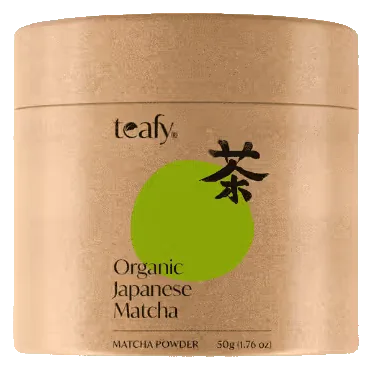
Teafy Organic Japanese Matcha kraft can with a soft green label
One swap a day is about $150 a month at the café, about $40 at home.That is not an argument for never going to the café. It is an argument for owning a whisk. The 50 g can is the bowl in every number on this page: shaded 20 to 25 days on the sixth generation family farm in Shizuoka where Teafy is the largest shareholder, 60 to 70 mg a 2 g bowl, lab tested in Victoria, about 25 bowls a can.
See the can

7. Pregnancy and sensitivity

Lower, not none.

200mg a day, the Australian ceiling in pregnancy

Food Standards Australia New Zealand and the Australian pregnancy guidance put the ceiling at 200 mg of caffeine a day during pregnancy. On the numbers above that is two brewed coffees, or about three 2 g bowls, or two 3 g lattes, or one 4 g bowl plus a little. Matcha is not caffeine free and should not be sold to you as the safe option. It is the lower option, and the gentler one. Talk to your doctor or midwife about what is right for you.

What 200 mg looks like
Two brewed coffeesabout 190 mg
Three 2 g bowls180 to 210 mg
Two 3 g lattes180 to 210 mg
One 4 g bowl, and a little120 to 140 mg

If you are sensitive to caffeine generally, the same logic applies: matcha is easier than coffee for most people because of the L theanine and the lack of acid, but a 3 g latte is still a real dose. Start with 1 g, a half scoop, and see. If you want the taste with most of the caffeine gone, that is what cold brewed sencha and hojicha are for.

8. The seven day swap

Replace one cup. Keep the rest.

Do not go cold turkey on coffee. Caffeine withdrawal headaches are real and they will put you off matcha for life. Replace one cup and let the week tell you something.

Day1Coffee as usual at 7. Second coffee becomes a 2 g bowl.Sift, 70 ml at 75 to 80 degrees, whisk 30 seconds.
Day2Same. Notice 3 pm. Most people report less of a wall.
Day3Same. Bitter means the water was too hot. Thin means less water, not more powder.
Day4Matcha first and coffee second. See which order you prefer.
Day5Make the second cup a 3 g latte instead of a bowl. Hot or iced.
Day6Anything after 3 pm becomes hojicha.16 to 30 mg, roasted, no whisk needed.
Day7Decide. Most people land on coffee at 7, matcha at 10, hojicha after lunch. Some go all matcha.

A 50 g can is about 25 bowls, so one can covers the week with change. If it sticks, the five pouch refill is the cheapest way to keep going.

Sources

Where the numbers come from.

Caffeine, coffeeUSDA FoodData Central, Standard Reference: coffee, brewed, prepared with tap water (about 40 mg per 100 g, 95 mg per 240 ml); coffee, brewed, espresso, restaurant prepared (about 212 mg per 100 g, 63 mg per 30 ml). fdc.nal.usda.gov
Caffeine, matcha and hojichaTeafy product pages: Ceremonial Grade Matcha, 60 to 70 mg per 2 g; Hojicha Powder, 16 to 30 mg per 2 g. Agrifood Technology report 485468, April 2026. 4 g and 3 g figures are the 2 g figure scaled.
Espresso doseCommon specialty coffee practice: 7 to 9 g of ground coffee for a single shot and 16 to 20 g for a double, 10 to 15 g for a brewed cup. Doses vary by café and roaster.
Trial, 2008Owen GN, Parnell H, De Bruin EA, Rycroft JA. The combined effects of L theanine and caffeine on cognitive performance and mood. Nutritional Neuroscience, 2008.
Trials, 2010Giesbrecht T, Rycroft JA, Rowson MJ, De Bruin EA. The combination of L theanine and caffeine improves cognitive performance and increases subjective alertness. Nutritional Neuroscience, 2010. Einöther SJ, Martens VE, Rycroft JA, De Bruin EA. L theanine and caffeine improve task switching but not intersensory attention or subjective alertness. Appetite, 2010.
PregnancyFood Standards Australia New Zealand caffeine guidance; Australian Government Pregnancy, Birth and Baby, caffeine in pregnancy, 200 mg a day. foodstandards.gov.au

Questions people ask

Matcha vs coffee, answered.

Does matcha have more caffeine than coffee?

Not at the usual dose. A 2 g bowl of Teafy ceremonial is 60 to 70 mg against about 95 mg for a 240 ml brewed coffee. A 3 g latte is close to a brewed coffee and a 4 g bowl is level with a double espresso. Gram for gram of dry product matcha is higher, but nobody drinks matcha by the cup of powder.

Is matcha better for you than coffee?

They are different, not ranked. Matcha brings L theanine, catechins and the whole leaf; coffee brings chlorogenic acids and a faster lift. Both have decades of research behind moderate use. If coffee gives you jitters or a sore stomach, matcha is usually the easier of the two.

Will matcha give me the same energy as coffee?

Similar total caffeine at a matched dose, delivered more evenly. Many people describe it as smoother, and without the drop two hours later. If you want the spike, drink the coffee.

Can I drink matcha instead of coffee every day?

Yes. One to three bowls a day is normal in Japan. Keep it before 3 pm, the same rule as coffee, and use hojicha after that.

Can I drink matcha when pregnant?

Australian guidance is under 200 mg of caffeine a day in pregnancy, which is about three 2 g bowls or two lattes. Matcha is lower than coffee, not caffeine free. Ask your doctor or midwife.

Why does matcha not give me jitters?

Two reasons supported by evidence: L theanine, which in trials softened caffeine's effect on attention and alertness, and the absence of coffee's acidity, which is often what the stomach is reacting to.

Which Teafy matcha for the coffee swap?

Ceremonial Grade for a bowl with water or a latte, $1.32 a bowl. If you only ever take it in milk, Superior Culinary is built for that and is cheaper a serve.

How do I make it without a whisk?

A small battery frother makes an acceptable latte paste. For a bowl with water the bamboo whisk is the difference between foam and lumps; the set is $59.99 and lasts.

Keep reading

Next.

Tomorrow at 10

One bowl instead of the second coffee.