
Lesson · Matcha grades
Ceremonial vs culinary matcha.
Two words on the front of every tin, and neither is an official Japanese grade. What actually separates them, the price gap at the farm, and which belongs in your cup.
EEric HuangTea instructor, TeafyPublished 11 November 20266 min read
The short answer
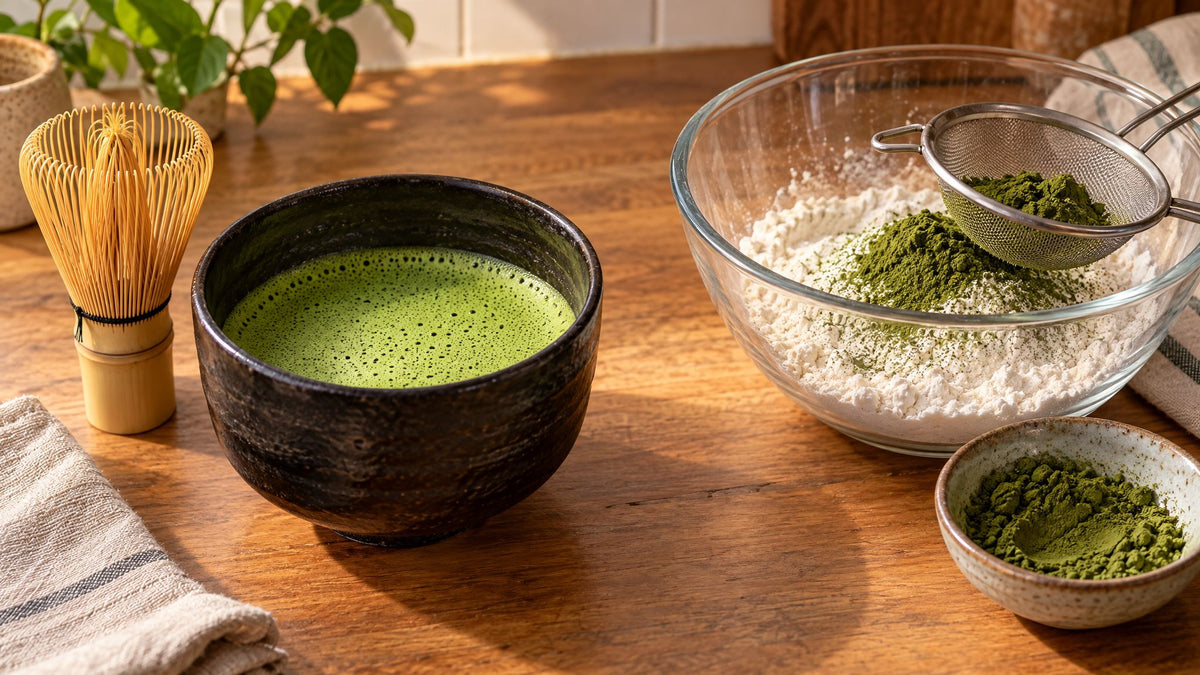
Ceremonial grade matcha is made from first flush, the youngest and most shaded leaves, stone milled very fine, and meant to be whisked with water. Culinary matcha uses later harvests, tastes bolder and more bitter, and is made for lattes and baking. Neither is an official Japanese grade; the real differences are harvest, leaf, shading and milling. In 2025, first flush tencha cost about twice second flush at the farm gate (MAFF).
In this guide
Lesson 1: the quick answer
Lesson 2: the four things that make the difference
Harvest
The first flush (ichibancha, 一番茶), picked from April into May, stores up amino acids like theanine, which taste sweet and savoury. Later harvests grow in summer heat and build more catechins, which taste bitter and drying.
Leaf position
Think of a shoot as a ladder. The top rungs are tender and sweet. Ceremonial grades use them. Culinary grades include the larger leaves lower down.
Shading
Shading before harvest makes the leaf greener and sweeter. Longer shading costs more, so it is saved for the leaf that will be drunk straight.
Milling
Granite stone mills grind slowly, which keeps the powder cool and extremely fine. Bead and jet mills are faster, and perfectly suited to culinary matcha, where the powder will meet milk, sugar or heat anyway.
Our tasting notes, scored 1 to 5.
Whisk it with water.
Built for milk and the oven.
Lesson 3: the price gap, from Japan's own data
Source: MAFF 茶をめぐる情勢, October 2026.
The leaf for ceremonial matcha cost about twice as much as culinary leaf before anyone milled or packed it. In 2026, first flush prices rose again: roughly double in Kagoshima and about 70% higher in Shizuoka.
So if a ceremonial tin costs the same as a culinary one, one of two things is true. The ceremonial is not first flush, or the culinary is overpriced.
Lesson 4: a tasting drill you can do at home
This is the drill I give students. Ten minutes, two bowls, and you will never confuse the grades again.
- Two bowls, same water2 g of each matcha in 70 ml of water at 80°C.
- Look firstCeremonial should be brighter jade. Culinary is deeper and more olive. Both are fine.
- Smell the foamCeremonial smells sweet and creamy. Culinary smells greener and sharper.
- Sip in the same orderNotice where the bitterness lands: at the end, or straight away.
- Now add milkPour 150 ml of warm milk into each. The culinary often wins here.
Lesson 5: which grade should you buy?
Myths worth dropping
Monthly Google searches in Australia. Demand climbed through winter 2026 to a peak of 14,800 in July.
Peak month for ceremonial grade matcha: Jul. Quietest: Dec.
Google Ads Keyword Planner, Australia, all languages, Google Search. Monthly figures are Google estimates, rounded into ranges.Questions people ask
What is ceremonial grade matcha?
Is ceremonial grade matcha an official grade?
Can I use ceremonial matcha in a latte?
Can I drink culinary matcha straight?
Why is ceremonial matcha more expensive?
Which matcha is best for baking?
Eric Huang
Tea instructor, Teafy
Eric is a Taiwanese tea instructor who teaches brewing technique. He writes lessons you can follow at the bench: ratios, temperatures, timing and the hand.
Sources
- Ministry of Agriculture, Forestry and Fisheries (MAFF), 茶をめぐる情勢, October 2026
- MEXT Food Composition Database, matcha (16035)
- Google Ads Keyword Planner, Australia, searches October 2025 to September 2026, checked 11 November 2026
We update this page when the numbers change, and date every change here.
Teas in this guide
Keep reading
 How to tell good matcha
 How to make matcha
 Matcha pancakes
 Matcha cultivars explained