
Field notes · Japanese tea
Gyokuro and kabusecha.
Matcha's cousins. Both are shaded before harvest like tencha, but rolled into leaf instead of milled to powder. One is Japan's most luxurious leaf tea, the other its best value secret.
HHiro OkumuraTea farmer, TeafyPublished 11 November 20265 min read
The short answer
Gyokuro (玉露) is Japanese green tea shaded for about 20 days before picking, then steamed and rolled. It tastes sweet, brothy and rich in umami. Kabusecha (かぶせ茶) is shaded for about a week and sits between gyokuro and sencha. Gyokuro is also the highest caffeine tea in Japan's food tables: about 160 mg per 100 ml when brewed the standard way.
In this guide
The covered tea family
In Japan, teas grown under cover have one name: hifukucha (被覆茶), covered tea. There are three. Each is shaded, then each goes its own way.
Typical shading before the first flush.
Source: MAFF 茶をめぐる情勢, October 2026.
How shade changes the leaf
Shade slows photosynthesis. The plant keeps more theanine, the amino acid that tastes sweet and brothy, instead of turning it into catechins, which taste bitter.
It also makes more chlorophyll. The leaf turns a deep, dark green. The longer the shade, the sweeter, more savoury and greener the tea.
Our tasting notes, scored 1 to 5.
Brothy and sweet.
A gentle middle.
Fresh and brisk.
How to brew gyokuro
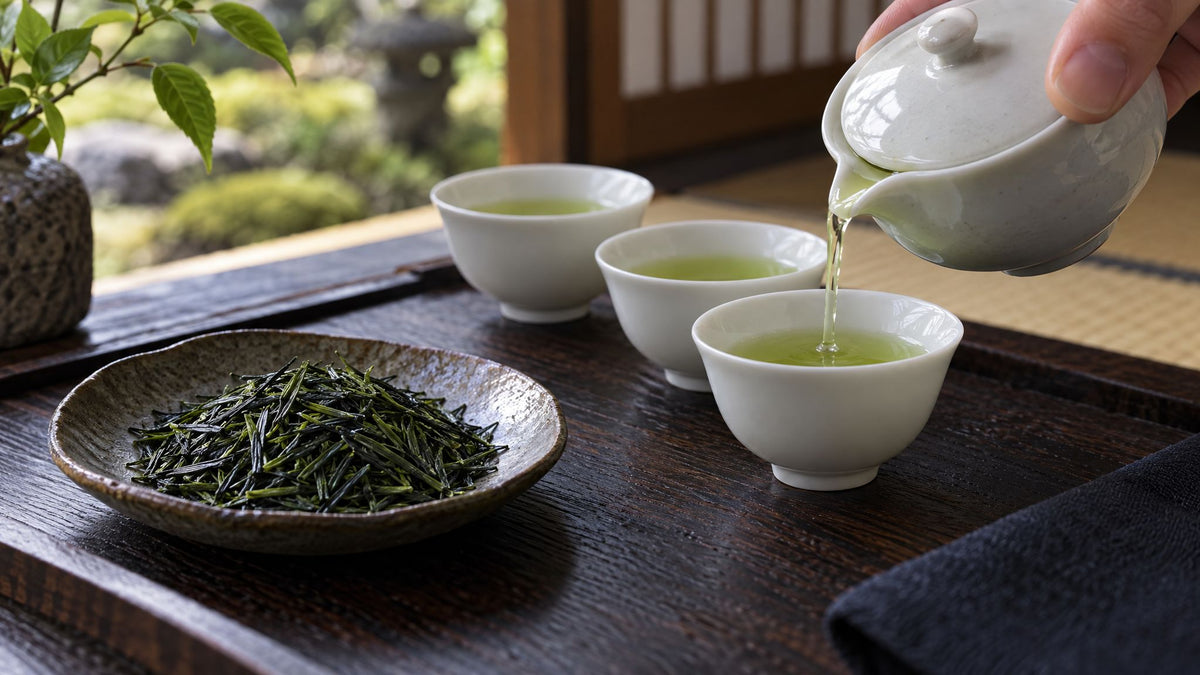
Gyokuro is brewed with a lot of leaf and very little cool water, almost like a broth. Sip it from small cups. Low heat brings out sweetness and keeps bitterness down.
- Cool the waterPour boiled water into the cups, then back into a jug. Each pour drops it about 10°C.
- Warm the potRinse a small pot or shiboridashi with hot water.
- Steep slowly10 g of leaf, 60 ml at 55°C, about two minutes.
- Pour every dropThe last drops are the richest. Shake the pot gently.
- Steep againHotter water, shorter time. Then eat the leaves with a little soy sauce, as some do in Japan.
A caffeine warning
Japan's food composition tables list gyokuro at about 160 mg of caffeine per 100 ml, brewed the standard way: 10 g of leaf in 60 ml at 60°C for 2.5 minutes. That is the highest of any tea in the tables, and higher per 100 ml than brewed coffee. Small cups are traditional for a reason.
Where they are grown
MAFF's figures show Mie ranks first for gyokuro and kabusecha. Kyoto and Fukuoka are also known for gyokuro; Fukuoka's Yame district is especially famous for it. Kyoto ranks second for both gyokuro and tencha, reflecting Uji's long history with shaded tea.
If you like gyokuro, try
Kyoto Uji matcha
Shaded single cultivar Okumidori, milled into powder. The same sweetness, whisked.
Asamushi sencha, brewed cool
60 to 70°C water brings out sweetness in good sencha.
Cold brew sencha
Cold water favours theanine over bitterness. Sweet and smooth.
Questions people ask
What is gyokuro?
What is the difference between gyokuro and sencha?
Does gyokuro have a lot of caffeine?
What is kabusecha?
What temperature should gyokuro be brewed at?
Is gyokuro the same as matcha?
Hiro Okumura
Tea farmer, Teafy
Hiro is a third generation Japanese tea farmer. He writes about the field: seasons, cultivars, shade and everything that happens to a leaf before it becomes tea.
Sources
- Ministry of Agriculture, Forestry and Fisheries (MAFF), 茶をめぐる情勢, October 2026
- Japan Standard Tables of Food Composition, 8th edition, 2023 supplement, via 全農 茶ガイド
- Google Ads Keyword Planner, Australia, searches October 2025 to September 2026, checked 11 November 2026
We update this page when the numbers change, and date every change here.
Teas in this guide
Keep reading
 Matcha cultivars explained
 Uji, Shizuoka and Kagoshima
 Matcha caffeine
 Cold brew green tea