
Lesson · Summer
Cold brew green tea.
Ten grams of sencha, a litre of cold water, a few hours in the fridge. The easiest summer drink there is, and it tastes sweeter than hot tea for a good reason.
EEric HuangTea instructor, TeafyPublished 11 November 20265 min read
The short answer
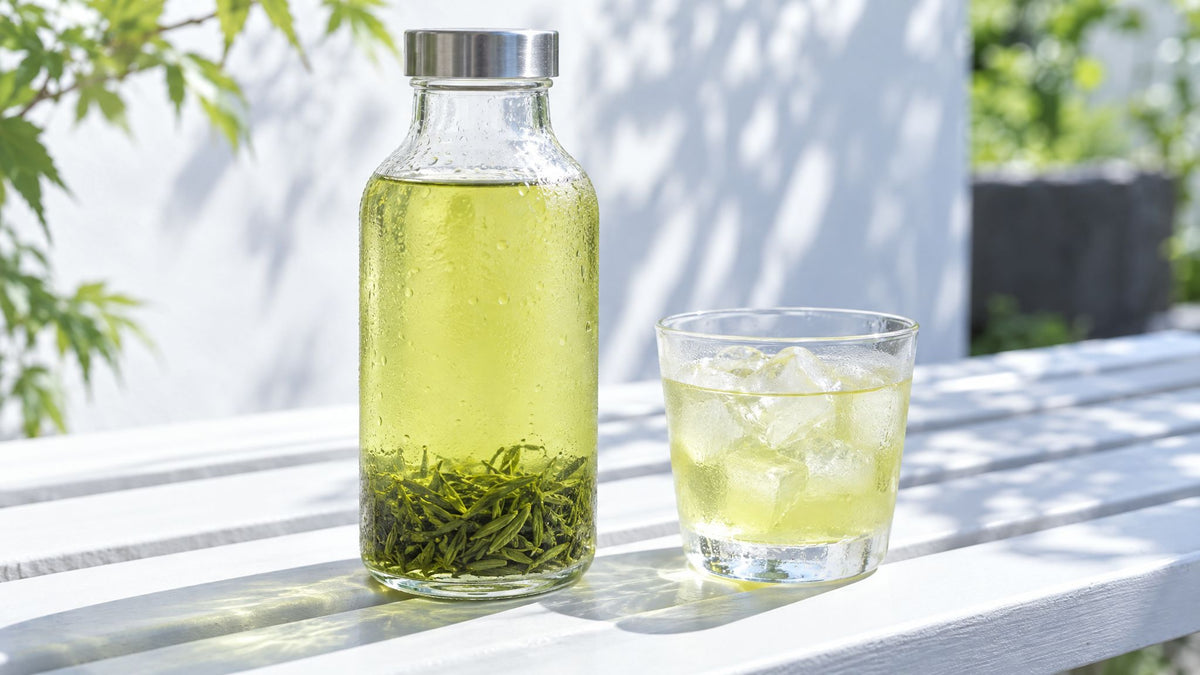
Put 10 g of sencha in 1 litre of cold filtered water, refrigerate for 3 to 6 hours, then strain. Cold water draws out sweet amino acids readily but far less of the bitter catechins and caffeine, so the tea tastes sweeter and softer than hot brewed sencha. Matcha is a powder, so it is shaken with cold water rather than brewed.
In this guide
Recipe card
Cold brew sencha (mizudashi)
Ingredients
- 10 g sencha (1 teaspoon is about 2.5 g)
- 1000 ml cold filtered water
Method
Tap a step to tick it off.
- Put the tea in a clean bottle or jug with a lid.
- Pour in the cold water, seal, and give it a gentle swirl.
- Refrigerate for 3 hours for a light tea, or up to 6 hours for a fuller one.
- Strain out the leaves and keep the tea in the fridge. Drink it within the day.
Lesson 1: why cold brew tastes sweeter
Every tea leaf holds three things that matter here. Amino acids, mostly theanine, which taste sweet and savoury. Catechins, which taste bitter and drying. And caffeine, which is bitter too.
Hot water pulls all three out fast. Cold water is selective. Amino acids dissolve readily even when cold. Catechins and caffeine come out much more slowly. So the balance in the cup shifts toward sweetness.
Our tasting notes, scored 1 to 5.
Soft and sweet.
More aroma, more bite.
Japan's agriculture ministry notes that cold brewed green tea holds a higher proportion of epigallocatechin (EGC) than hot brewed tea, and that this has been studied in human trials that began in fiscal 2021. That is research in progress, not a health claim. It does show cold brew is more than a fashion.
Lesson 2: choose your leaf
Fukamushi leaves are finer, so they give up flavour and colour faster. Asamushi's whole needles take longer and give a clearer, more delicate tea.
Lesson 3: three ways to cold brew
Mizudashi 水出し
Leaf in cold water in the fridge, 3 to 6 hours. The sweetest, softest result.
Kōridashi 氷出し
Leaf under a pile of ice, left to melt over an hour or two. Tiny amount, intensely sweet and thick. Best with gyokuro or a good asamushi.
Flash chilled
6 g of sencha in 150 ml of 70°C water for 1 minute, poured straight over a glass packed with ice. Ready in two minutes, more aroma, a little more bite.
Lesson 4: cold brew matcha
Matcha is a powder of the whole leaf. There is nothing to strain, so it is not brewed at all. It is mixed.
- Sift 2 g of matcha into a jarSifting stops cold water clumps.
- Add 200 ml of cold waterFiltered is best.
- Seal and shake hardAbout 20 seconds, until frothy.
- Pour over iceDrink straight away; the powder settles if it stands.
Lesson 5: food safety
Cold brewed tea has not been heated. Treat it like any fresh drink.
- Clean bottle, washed in hot soapy water and rinsed.
- Fridge the whole time. Never on the bench in summer.
- Drink within the day.
- Strain the leaves once it tastes right; left in, it keeps getting stronger.
Questions people ask
How long should you cold brew green tea?
Is cold brew green tea lower in caffeine?
How much tea do I use for a litre?
Can I cold brew matcha?
How long does cold brew tea last?
Can I cold brew hojicha or genmaicha?
Eric Huang
Tea instructor, Teafy
Eric is a Taiwanese tea instructor who teaches brewing technique. He writes lessons you can follow at the bench: ratios, temperatures, timing and the hand.
Sources
- Ministry of Agriculture, Forestry and Fisheries (MAFF), 茶をめぐる情勢, October 2026, on cold brewed green tea and EGC research
- Japan Standard Tables of Food Composition, 8th edition, 2023 supplement, via 全農 茶ガイド
- Google Ads Keyword Planner, Australia, searches October 2025 to September 2026, checked 11 November 2026
We update this page when the numbers change, and date every change here.
Teas in this guide
Keep reading
 Iced matcha latte
 Shincha and the tea seasons
 Gyokuro and kabusecha
 Genmaicha, explained