
Explainer · Recipe and cost
The matcha latte, at home.
Two grams of matcha, a splash of hot water, a cup of steamed milk. The cafe latte in three minutes, the ratios for every style, and what it costs against the $8.79 cafe average.
LLauren PollockOperations manager, TeafyPublished 11 November 20266 min read
The short answer
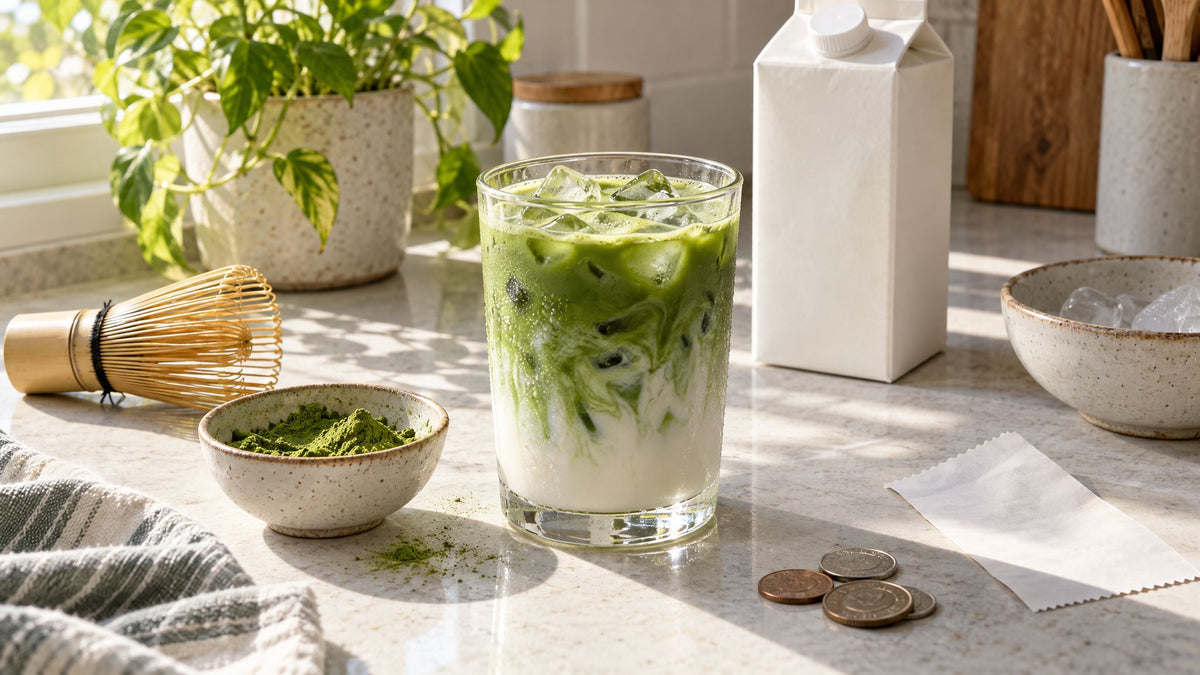
Sift 2 g of matcha into a mug, whisk it with 40 ml of water at about 80°C until smooth, then pour in 180 ml of milk steamed to about 60°C. Sweeten if you like. At home that costs about $1.30 to $3 a cup depending on the matcha and milk, against an average cafe matcha latte of $8.79 in 2026 (Square data).
In this guide
Recipe card
Matcha latte
Ingredients
- 2 g matcha (1 level teaspoon is about 2 g)
- 40 ml water at about 80°C
- 180 ml milk
- Honey, maple or vanilla syrup to taste (optional)
Method
Tap a step to tick it off.
- Sift the matcha into a wide mug or bowl.
- Add the 80°C water and whisk in a quick M or W motion for 20 to 30 seconds, until smooth with a fine foam.
- Heat the milk to about 60°C and froth it with a steam wand, a handheld frother or by shaking it in a sealed jar.
- Pour the milk into the matcha, holding back the foam with a spoon, then spoon the foam on top.
- Taste, then sweeten if you like. Stir syrup into the matcha shot so it mixes evenly.
What you need to know
That is the whole method. Everything else on this page is about getting it to taste exactly how you like it.
Ratios for every style
No whisk? Three ways that work
Pick your matcha and milk
Our tasting notes, scored 1 to 5.
Bold through milk.
Smoother and sweeter.
Best whisked straight.
What it costs: cafe vs home
Square's sales data, reported by ChannelLife in 2026, found matcha was the most expensive drink on the cafe menu. Cafe owners have been open about why: SBS News reported in October 2025 that one Melbourne cafe owner had seen the price of top tier Japanese matcha rise by more than a quarter in twelve months, and warned matcha lattes could pass $12.
Teafy prices, November 2026. Milk assumes about 200 ml of dairy at typical supermarket prices; barista oat costs a little more.
A bamboo whisk and holder is a one off $32.99. At cafe prices it pays for itself in about five homemade lattes.
Why cafe matcha costs more
- More matcha per cup. Cafes often use 3 to 5 g to stand up to a big cup of milk.
- Rent, wages and milk. The same costs behind every coffee.
- Waste. Opened matcha fades within weeks, and cafes bin what goes dull.
- The 2026 harvest. First flush prices roughly doubled in Kagoshima and rose about 70% in Shizuoka (MAFF).
Fixes for common latte problems
Monthly Google searches in Australia for matcha latte.
Peak month for matcha latte: Nov. Quietest: Sep.
Google Ads Keyword Planner, Australia, all languages, Google Search. Monthly figures are Google estimates, rounded into ranges.Questions people ask
How do you make a matcha latte at home?
How much matcha do you put in a latte?
Can you make a matcha latte without a whisk?
How much does a matcha latte cost in Australia?
What milk is best for a matcha latte?
How much caffeine is in a matcha latte?
Lauren Pollock
Operations manager, Teafy
Lauren is the operations manager at Teafy. She writes the explainers and comparisons, the side by side pages that settle a question in a few minutes.
Sources
- ChannelLife, Australia coffee sales fall as prices climb higher, Square data, 2026
- SBS News, Australian matcha demand and cafe prices, 25 October 2025
- Ministry of Agriculture, Forestry and Fisheries (MAFF), 茶をめぐる情勢, October 2026
- MEXT Food Composition Database, matcha (16035): caffeine 3.2 g per 100 g
- Google Ads Keyword Planner, Australia, searches October 2025 to September 2026, checked 11 November 2026
We update this page when the numbers change, and date every change here.
Teas in this guide
Keep reading
 Best milk for matcha
 Iced matcha latte
 Ceremonial grade matcha
 How to make matcha